
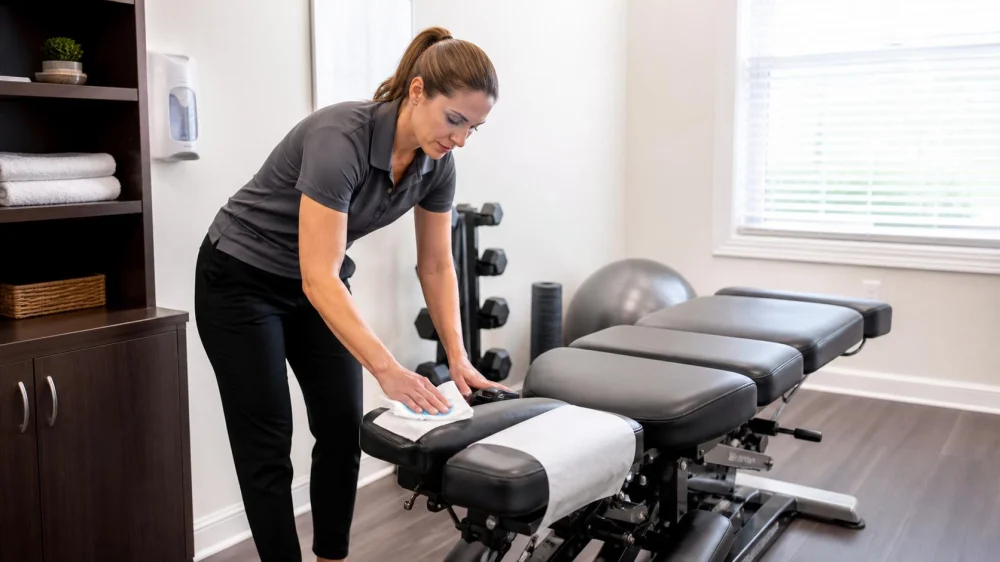
Chiropractic Clinic Hygiene: What Patients Can Observe
On this page
Quick answer
A chiropractic clinic should be able to explain how it cleans treatment tables, face cushions, reusable tools, exercise equipment, and high-touch surfaces; how staff perform hand hygiene; and how it handles illness, linens, and visible contamination. Patients can look for clean intact surfaces, fresh barriers or linens, available hand hygiene, and tools stored appropriately. Ask before contact if a surface or item appears unclean.
This guide is for patients comparing chiropractic clinics in the United States. A tidy appearance cannot prove full infection control, and requirements vary by state, procedure, product, and current public-health guidance. The clinic should follow applicable professional and manufacturer instructions.
Questions before booking
Ask concise practical questions rather than requesting a vague promise that everything is “sanitary.”
- How are treatment-table surfaces and face cushions cleaned between patients?
- Are face-paper barriers single-use, and is the underlying surface also cleaned as required?
- How are reusable therapy tools and exercise items cleaned?
- Are cloth covers, gowns, and towels changed and laundered between patients?
- What should a patient do if they have fever, vomiting, a contagious rash, or respiratory symptoms?
- Can an appointment be rescheduled or converted to a remote discussion when appropriate?
A clear answer should identify a process. Staff may not name every chemical, but they should know which items are cleaned, when, and by whom.
What to observe at the clinic
Look for hand-hygiene supplies that are accessible to staff and patients, intact treatment surfaces that can be cleaned, covered waste containers where needed, and separation between clean and used linens. Staff should not move from phones, keyboards, or visibly soiled items directly to patient contact without appropriate hand hygiene.
A practitioner may need to touch the head, face, neck, feet, or other body areas during examination or care. It is reasonable to ask for hand hygiene before contact. Gloves are not required for every routine touch and do not replace clean hands; they are used according to exposure risk and procedure.
Odor is not a reliable cleanliness test. Strong fragrance can mask smells and may affect sensitive patients. A surface can look clean while still requiring disinfection, and a properly cleaned clinic need not smell like chemicals.
Shared equipment and surfaces
Treatment tables, drop pieces, face cushions, straps, exercise balls, bands, foam rollers, handheld instruments, weights, pens, tablets, door handles, and payment devices can pass through many hands. The appropriate cleaning method depends on the material and how it is used.
Disinfectants need the correct concentration and wet contact time. Spraying and immediately wiping may not follow the product label. At the same time, excessive or incompatible chemical use can damage table upholstery and tools, creating cracks that are harder to clean.
Single-use face paper protects one area but does not automatically clean the cushion, table edge, or adjustment controls. Reusable fabric covers require a controlled laundry process and replacement between patients as indicated.
How to raise a concern
- Pause before lying down or using the item.
- Describe the specific concern: “There is visible residue on the face cushion.”
- Ask whether the surface can be cleaned or the item replaced.
- Allow the required product contact and drying time.
- If the response is dismissive or the clinic cannot provide a clean alternative, decline that part of the visit.
- Document a serious exposure and seek medical or regulatory guidance when appropriate.
Patients do not need to apologize for a hygiene question. A professional clinic should respond without shaming the patient.
Important limits
This checklist cannot assess air handling, water systems, laundry processing, chemical dilution, or staff training from the waiting room. Licensure does not guarantee that every daily task is performed correctly, and an online review is not proof of a current violation.
People who are immunocompromised, have open wounds, recent surgery, a contagious condition, or special infection-control needs should coordinate with their medical clinician and the clinic before arrival. Manual care should not proceed over an infected or unexplained skin lesion without appropriate evaluation.
Patient checklist
- Clinic explains between-patient cleaning clearly.
- Table and face cushion are intact and visibly clean.
- Fresh barrier or linen is used as appropriate.
- Reusable tools are stored clean and dry.
- Used and clean linens are separated.
- Hand hygiene occurs before relevant patient contact.
- Staff respond respectfully to specific concerns.
- Illness rescheduling policy is clear.
Frequently asked questions
Does face paper mean the cushion is clean?
Not necessarily. It is a barrier for one contact surface. The cushion and surrounding table still need the clinic's required cleaning and inspection.
Should a chiropractor wear gloves?
Gloves are selected according to exposure and procedure, not for every routine touch. Hand hygiene remains essential. Ask when you have a specific wound or exposure concern.
Can I bring my own towel?
Ask the clinic first. A personal towel does not replace cleaning and can itself become contaminated. The clinic should provide an appropriate clean surface.
What if I am sick on appointment day?
Call before arriving and follow the clinic's policy and medical guidance. Rescheduling may protect staff and other patients and may be medically appropriate.
Where can I report a serious concern?
Start with clinic management when safe. State chiropractic licensing boards, health departments, workplace-safety agencies, or other bodies may have jurisdiction depending on the issue. Use current official contact information.
Sources and evidence notes
This article reflects general outpatient infection-control practice: hand hygiene, correct product contact time, cleaning between patients, material compatibility, linen separation, and staying home when contagious. State requirements and procedure-specific guidance determine exact practice.
Next steps
Before booking, ask how the clinic cleans the table, face cushion, tools, and linens. At the visit, pause if you see residue, damage, or a used barrier and request correction before contact. Combine hygiene observations with licensure, communication, informed consent, and care-plan quality when choosing a clinic.




 Henriques Donald P DC4.0 (6 reviews)
 Sarpy Chiropractic - West Omaha4.0 (392 reviews)
 Ewing Chiropractic Family Clinic4.0 (6 reviews)
 Jeong Wellness Chiropractic5.0 (11 reviews)
 Abrams Chiropractic Clinic4.0 (14 reviews)
 Christopher J. Horak, D.C.5.0 (24 reviews)
 Chiropractic for Post-Surgical Recovery: Accelerating Healing and Pain Relief
 How Chiropractic Adjustments Can Enhance Your Body’s Flexibility
 Expert Tips for Managing How Chiropractors Treat Migraines Naturally with Chiropractic Care
 10 Things You Should Know About TMJ and Chiropractic
 How Chiropractic Care Benefits Seniors | Treating Age-Related Issues
 How to Find a Chiropractor That Treats Children with Pediatric Experience