
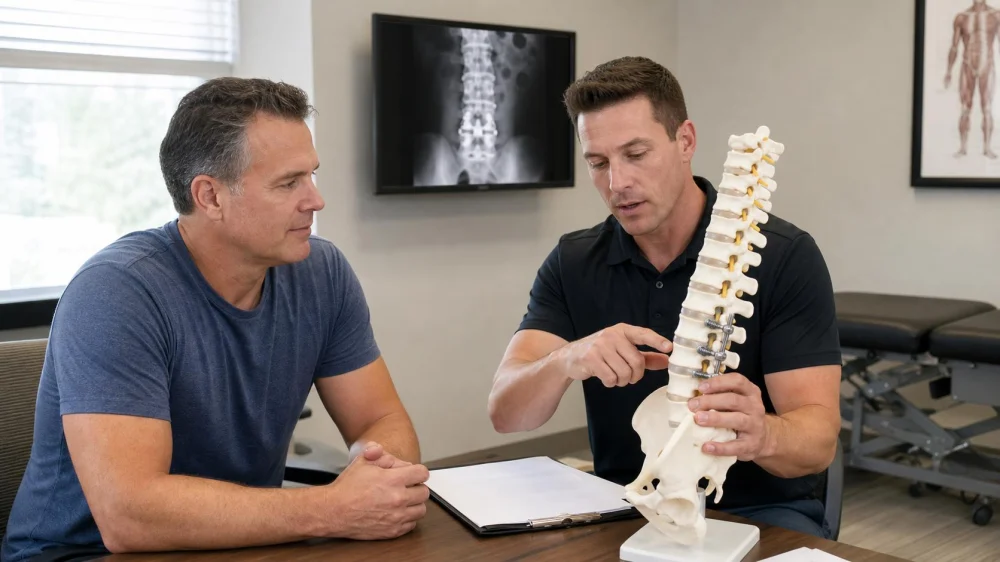
Chiropractic Care After Spine Surgery: Questions Before a Visit
On this page
Quick answer
After spine surgery, do not assume that a past recovery date makes every chiropractic technique appropriate. Ask the surgeon or current spine clinician whether any restrictions remain, bring the operative report and recent imaging, disclose hardware, fusion levels, complications, medications, and neurologic symptoms, and require the chiropractor to explain how the plan avoids or accounts for the surgical area. New weakness or bladder or bowel changes need urgent medical care.
Post-surgical chiropractic care means evaluation or conservative treatment sought after an operation involving the cervical, thoracic, lumbar, or sacral region. It may include education or non-manipulative approaches as well as manual therapy. The safety decision depends on the exact procedure, healing, anatomy, symptoms, and clinician competence—not the label “post-op” alone.
Why prior spine surgery changes the decision
Fusion changes motion between vertebrae. Disc replacement, decompression, laminectomy, implanted stimulators, screws, rods, cages, bone grafts, and other procedures create different structural and healing considerations. Scar tissue, altered sensation, adjacent-level movement, bone health, and the reason for surgery also matter.
A symptom after surgery may relate to muscles or joints, but it can also signal hardware problems, infection, recurrent nerve compression, fracture, or another condition outside chiropractic scope. Screening and record review should come before deciding on hands-on care.
Before booking a visit
- Identify the clinical question. Clarify whether the goal is pain discussion, mobility, exercise guidance, return to activity, or another concern.
- Contact the surgical team. Ask whether the healing phase is complete, what movements or forces remain restricted, and which symptoms require reassessment.
- Verify the chiropractor. Check the active state license and ask about experience with the exact type of post-surgical patient.
- Ask about records review. Confirm the clinician will examine operative information and coordinate with the spine team when needed.
- Separate evaluation from treatment. Request an assessment first and retain the option to decide about care afterward.
A casual statement that care is always safe after a fixed number of weeks is not enough. Healing timelines and restrictions are individual.
Records and details to gather
- Procedure name, date, surgeon, facility, and the levels involved.
- Operative report and discharge or rehabilitation instructions.
- Implant card and device information, including spinal cord stimulators or pumps.
- Recent imaging reports and the reason each image was obtained.
- History of infection, nonunion, hardware failure, revision, fracture, or blood clot.
- Current medications, especially anticoagulants, steroids, pain medicine, and osteoporosis treatment.
- Current symptoms, including weakness, numbness, balance change, fever, wound change, or bladder and bowel function.
- Current physical therapy, exercise restrictions, work limits, and upcoming follow-up appointments.
Do not rely only on memory when the procedure was complex. Request records through the treating facility and obtain permission for clinicians to communicate directly.
Questions for the chiropractor
- What diagnoses or causes are you considering, and what must be ruled out first?
- Have you reviewed the operative level, hardware, restrictions, and imaging reports?
- Will you contact the surgeon or spine clinician before proposing treatment?
- Which areas would you examine or treat, and which would you avoid?
- Are thrust manipulation, traction, flexion-distraction, or other forces proposed?
- What lower-force, exercise-based, or non-manipulative alternatives exist?
- What benefit is realistic, what are the material risks, and what is uncertain?
- How will function be measured and when will lack of progress trigger referral?
- What new symptoms require stopping immediately?
The clinician should be able to name the limits of their assessment and explain why a method fits the specific anatomy. Refusal to review records, guaranteed outcomes, or pressure for a prepaid long plan are reasons to pause.
Discuss technique and alternatives
“Chiropractic care” is not one technique. Options may include education, activity modification, graded exercise, soft-tissue work, gentle mobilization away from restricted areas, or referral. Some approaches may still be unsuitable depending on fusion, instability, device instructions, bone health, and neurologic findings.
Terms such as “gentle” and “low force” are not precise enough for consent. Ask what body position, direction, contact point, force, equipment, and treatment region are planned. A person can decline any element and request another option.
Do not let anyone adjust, pull, or apply a device over a surgical region without an individualized assessment and a clear rationale. Manufacturer restrictions for implanted devices also apply.
Pre-visit checklist
- Procedure, level, date, hardware, and restrictions are documented.
- Surgical follow-up and current healing status are known.
- New or progressive neurologic symptoms have been medically evaluated.
- Medication, bone health, cancer, infection, and fall history are disclosed.
- Chiropractor's license and relevant experience are verified.
- Records review and medical coordination are agreed upon.
- Technique, contact area, alternatives, risks, and stop rules are understandable.
- A functional goal and reassessment point are set.
Limitations and urgent red flags
Seek emergency evaluation for new loss of bladder or bowel control, saddle-area numbness, rapidly worsening weakness, sudden one-sided weakness, severe new headache, chest pain, breathing difficulty, collapse, or major trauma.
Contact the surgical or medical team promptly for fever with spinal pain, wound drainage or redness, increasing night pain, new numbness, worsening balance, unexplained weight loss, a new deformity, or a sudden change after a fall. Do not mask these signs with repeated manual treatment.
Chiropractic care cannot verify fusion, reposition hardware, treat infection, reverse nerve damage, or guarantee avoidance of revision surgery. Imaging and specialist review may be required based on symptoms and the procedure history.
Sources and evidence notes
This article applies broad post-surgical and musculoskeletal safety principles: identify the procedure, respect restrictions, screen neurologic and systemic red flags, review records, coordinate clinicians, and choose force and location based on altered anatomy. Evidence for specific techniques after specific operations is not interchangeable.
Use the operating surgeon or current spine clinician, operative and imaging reports, device manufacturer instructions, the state chiropractic licensing board, and current clinical guidance as primary sources. Individual clearance is not a guarantee; the treating clinician still must assess each visit.
Frequently asked questions
How long after spine surgery can someone see a chiropractor?
There is no universal waiting period. Procedure, healing, complications, imaging, bone health, symptoms, and surgeon restrictions determine timing. Obtain individual guidance from the surgical team.
Can a chiropractor adjust above or below a fusion?
Location alone does not establish safety. Adjacent areas may have altered mechanics, and symptoms may require medical evaluation. The chiropractor should review records, examine the patient, coordinate when needed, and explain the exact proposal.
Is an X-ray always needed first?
No single imaging rule fits every case. Existing post-operative imaging may be sufficient, outdated, or unrelated to the current symptom. Imaging should be ordered only when clinically indicated and interpreted in context.
What if the surgeon and chiropractor disagree?
Pause the proposed care and ask both clinicians to communicate with shared records and specific reasoning. A second opinion from an appropriate spine or rehabilitation specialist may help resolve the question.
Can massage or exercise replace an adjustment?
They are different interventions and may be considered depending on the diagnosis, restrictions, and goals. Even seemingly gentle exercise or soft-tissue work needs modification when healing, hardware, or neurologic symptoms are involved.
Conclusion and next steps
Start with the operative details, current restrictions, and the new clinical goal. Ask the spine team what must be avoided, verify the chiropractor, and schedule evaluation rather than automatic treatment. A safe plan is specific about anatomy, technique, coordination, stop rules, and when another professional should take over.






 Hah Chiropractic5.0 (43 reviews)
 Tribeca Chiropractic, PLLC5.0 (3 reviews)
 Long Lisa a DC4.0 (6 reviews)
 Reactivate Chiropractic & Rehab4.0 (72 reviews)
 Kuhns Chiropractic5.0 (3 reviews)
 Body Solutions Chiropractic and Rehabilitation Center4.0 (18 reviews)
 How to Verify a Chiropractor's License and Credentials
 What Causes Chiropractic Side Effects and How Chiropractors Treat It
 Best Chiropractic Treatments for Frozen Shoulder Relief According to Experts
 How Chiropractic Care Can Help Reduce Your Stress and Improve Mental Clarity
 Everything You Need to Know About Chiropractic Techniques from a Chiropractic Perspective
 How Chiropractors Help With Desk Job Posture Problems and Why It Works