
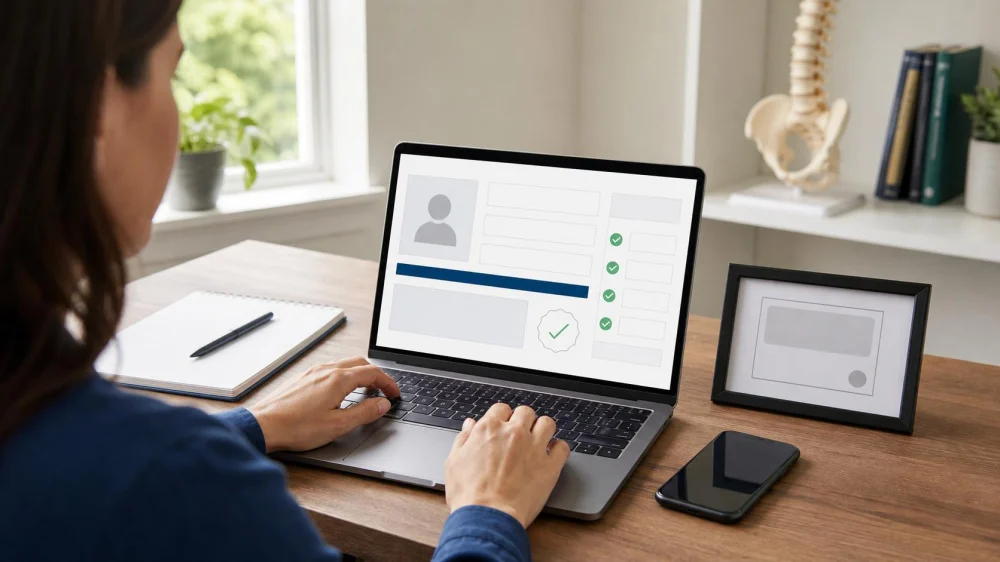
How to Verify a Chiropractor's License and Credentials
On this page
- Quick answer
- License versus credential
- Search the state board
- Match the correct person and location
- Review public discipline carefully
- Verify additional credentials
- Check insurance and business details
- Questions to ask the clinic
- Limitations and important notes
- Frequently asked questions
- Sources and evidence notes
- Next steps
Quick answer
Verify a U.S. chiropractor through the official licensing board for the state where care will occur. Match the full name, license number, status, expiration, and practice location, then open any public disciplinary documents. Check specialty certificates with the organization that issued them and confirm insurance participation directly with both the clinic and health plan. Save dated results before booking.
License versus credential
A professional license is legal authorization from a state regulator to practice within that state's scope and rules. A credential is broader: it may be a degree, examination result, postdoctoral certificate, membership, training course, or marketing designation.
The National Board of Chiropractic Examiners administers examinations used by state boards, but NBCE does not issue a license to practice. Passing an exam, graduating from a program, or joining an association does not replace an active license in the state where the patient receives care.
Search the state board
- Identify the state where the appointment will physically occur, including telehealth-related services when applicable.
- Find that state's official chiropractic board or professional licensing agency through a state government website.
- Search the chiropractor's full legal name. Use the license number when the clinic provides it.
- Confirm that the profession shown is chiropractic and the status is active or otherwise valid for current practice.
- Check issue and expiration dates, renewal status, limitations, conditions, and public board actions.
- Save a PDF, screenshot, or printed result with the search date and official page address.
A directory listing, clinic profile, map result, or social account can help locate a provider but is not an official license verification source.
Match the correct person and location
Common names and recent moves can cause mismatches. Compare the middle name or initial, license number, city, clinic address, and other board-provided identifiers. If a professional holds licenses in several states, verify the relevant one separately.
Call the board using contact information on its official site when a record is missing, ambiguous, expired, or listed under a former name. Do not assume that a clinic's business license belongs to every treating professional.
Review public discipline carefully
Some board systems show a simple indicator; others link to orders, consent agreements, suspensions, probation terms, or closed cases. Read the underlying public document when available. Record the date, allegation or finding, outcome, current conditions, and whether the action remains in force.
No displayed action does not guarantee that no complaint was ever made; complaint records and disclosure rules vary. Likewise, a historical action needs context rather than an automatic conclusion. The board can explain what its public record represents.
Verify additional credentials
- Degree: Ask for the school and graduation information; confirm institutional accreditation relevant at the time when this matters to your decision.
- Diplomate or specialty certificate: Identify the issuing body, requirements, date, renewal, and whether it offers a public verification tool.
- Technique certificate: Ask how much training was required and whether the term is a regulated specialty or a private course credential.
- Association membership: Verify with the association, but treat membership as participation rather than state authorization or proof of outcomes.
- Hospital or team affiliation: Confirm with the named organization rather than relying on a profile badge.
Ask what an abbreviation means. A long string of letters can combine a required degree, an optional certificate, a membership, and a course completion with very different levels of oversight.
Check insurance and business details
License verification does not establish that a clinic is in-network, that a service is covered, or that the listed practitioner will personally provide treatment. Call the health plan using the number on your card and confirm the provider, location, network, referral rules, visit limits, and relevant billing codes.
Then ask the clinic to confirm the treating professional, legal business name, itemized fees, cancellation terms, and what services may be billed separately. Compare both answers because online network directories can lag behind contract changes.
Questions to ask the clinic
- Who will perform my examination and any treatment?
- What is that clinician's state license number?
- Is the license subject to current restrictions or supervision?
- What does each advertised specialty credential mean, and who issued it?
- How do you handle symptoms that need medical referral or emergency care?
- Will I receive an assessment, options, material risks, and estimated cost before treatment?
- Are packages optional, and what are the refund and cancellation terms?
Limitations and important notes
Licensing systems, scopes of practice, renewal cycles, and public-record rules vary by state and change over time. Use the current official regulator and contact it when the database is unclear. This article does not interpret a specific disciplinary record or provide legal advice.
Credentials help establish authorization and training; they do not guarantee diagnosis, communication, safety, or outcome. Evaluate whether the clinician takes a complete history, screens red flags, explains alternatives, welcomes questions, and refers appropriately.
Frequently asked questions
Is an NBCE result the same as a chiropractic license?
No. NBCE administers examinations used in licensure decisions. The relevant state board reviews requirements and issues the license.
What does an inactive or expired status mean?
It may mean the person is not currently authorized to practice under that license. Do not guess from the label; ask the state board and clinician for clarification before receiving care.
Can a chiropractor practice in every state with one license?
No. Chiropractic practice is regulated by jurisdiction, and a practitioner must have authority where the care occurs. Verify each relevant state.
Does “board certified” always mean the same thing?
No. Ask which board, what subject, whether it is recognized or regulated, what requirements apply, and how to verify current status.
Is an active license enough to choose a chiropractor?
It is an essential threshold, not the entire decision. Consider scope, experience with your concern, referral practices, communication, treatment options, cost, and your comfort with informed consent.
Sources and evidence notes
The National Board of Chiropractic Examiners' certification and licensure overview explains that NBCE administers exams while state boards determine eligibility and issue licenses. Its state licensing board directory provides a starting point; users should confirm that any destination is the current official regulator.
Next steps
Ask the clinic for the treating chiropractor's full name and license number. Verify both on the official state board site, save the dated result, and review any linked order. Then confirm optional credentials with their issuers and network status with your insurer before agreeing to an appointment plan.




 Health Centered Chiropractic5.0 (104 reviews)
 David G. Hecht, DC5.0 (166 reviews)
 Nebiosini Richard A DC5.0 (2 reviews)
 Back 2 Health Family Wellness Center4.0 (201 reviews)
 Costa Vista Chiropractic Barnette Corporation4.0 (254 reviews)
 Dr. Jessica Grichy, D.C5.0 (1 reviews)
 Chiropractic Advice for Better Sleep and Posture | ChiroScope
 Can Chiropractic Care Solve Your Pregnancy and Chiropractic Problem – ChiroScope
 Chiropractic Care and Myths You Should Know: Expert Advice
 How to Relieve TMJ and Chiropractic Without Medication – Chiropractor Approved
 How to Sit at Your Desk to Avoid Back Pain: Chiropractor Approved Tips for a Healthy Workstation
 Chiropractic vs Traditional Chinese Medicine for Pain Relief Explained