
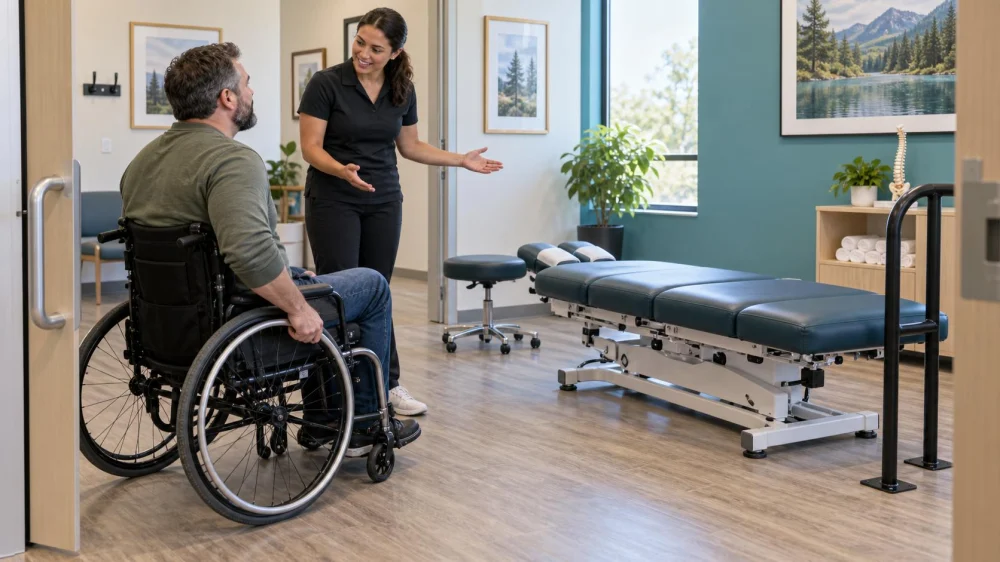
Chiropractic Clinic Accessibility: Entry, Tables, and Transfers
On this page
Quick answer
Before booking, describe the access features you need and ask the clinic to verify the route, doorway, treatment room, table height, clear transfer space, and staff assistance. Agree on a safe transfer plan before the visit. Accessibility is part of receiving comparable care, and a patient should not be forced to improvise an unsafe lift or transfer.
Call ahead with specific questions
“Is the clinic accessible?” may produce an incomplete answer. Ask someone who knows the physical space and equipment to check the details. Explain whether you use a manual or power wheelchair, walker, cane, service animal, transfer board, personal aide, or other support.
- Is there an accessible parking space or drop-off route?
- Are curb cuts, ramps, elevators, and doors usable along the full path?
- What is the narrowest doorway, and are thresholds present?
- Can the treatment table lower to a transfer height?
- Is clear floor space available beside the table on your preferred side?
- What trained staff help and transfer equipment are available?
Ask the clinic to note the agreed arrangements in the appointment record and provide a contact for changes.
Check the route and entry
Accessibility starts before the treatment room. Confirm the route from parking, transit, or drop-off to reception. Ask about exterior slopes, heavy doors, call buttons, elevator dimensions, check-in height, seating, and an accessible restroom. Construction or a broken elevator can change a route, so reconfirm near the appointment date when those risks apply.
The U.S. Department of Justice describes an accessible examination room as connected to an accessible route and having adequate door and maneuvering clearances. A door that opens into clear floor space or stored equipment can still create a barrier even if its nominal width seems sufficient.
Confirm room and table access
Ask whether the room has enough space to approach, turn, position mobility equipment, and reach the table. DOJ guidance identifies a 30-by-48-inch minimum clear floor space adjacent to an exam table and describes a 32-inch minimum clear doorway opening for an accessible examination room. Exact needs can be greater depending on your device and transfer method.
An accessible table should lower near wheelchair-seat height and have supports that can help with positioning and stability. Ask about adjustable rails, straps, wedges, cushions, headrests, and space for a lift if one is needed. A standard high table plus a step stool is not an equivalent solution for someone who cannot use it safely.
Make a transfer plan
Tell staff how you usually transfer, which side you use, what help is safe, and what assistance you do not want. The patient should direct the transfer whenever possible. Staff should not lift a person manually without a safe plan, training, and appropriate equipment.
- Position the table, wheelchair, brakes, footrests, and supports before moving.
- Clear bags, stools, cords, and other obstacles.
- Agree on who will assist and what each person will do.
- Pause if the table, board, lift, or floor position is unstable.
- After transfer, confirm comfort, balance, reach, and call access.
DOJ guidance advises staff to ask whether assistance is needed and not leave a patient unattended unless the patient says assistance is unnecessary.
Plan communication and assistance
Access can also involve effective communication, extra positioning time, a support person, or a service animal. Ask how the clinic handles these needs and whether forms can be completed in an accessible format before arrival. If a personal aide attends, clarify that the patient remains the person giving consent and directing care.
If the clinic cannot provide a needed feature at the selected location, ask about another room, location, appointment time, equipment arrangement, or reasonable modification. Do not accept a plan that skips a necessary examination simply because equipment is inaccessible. Clinical decisions should be based on health needs, not on the convenience of the room.
Frequently asked questions
Should I bring my own transfer board?
Tell the clinic what you normally use and ask whether bringing it is appropriate. The clinic still needs a safe space, compatible equipment, and trained assistance for the agreed plan.
Can a family member lift me onto the table?
Do not assume this is safe. Discuss your established method, equipment, and assistance needs in advance. An improvised manual lift can injure both people.
What if I can remain in my wheelchair?
Some parts of an assessment may be possible while seated, but the clinician should determine what examination is clinically necessary and provide accessible equipment or arrangements when a transfer is needed.
Should I visit the clinic before the appointment?
A brief access check can help when measurements, equipment, or routes are uncertain. Confirm that the room and table you inspect will be available for your appointment.
What if access changes on the day?
Call the clinic, describe the new barrier, and ask for a safe alternative. Do not attempt a route or transfer that you believe is unsafe.
Conclusion and next steps
Write a short list of nonnegotiable access needs, call the clinic, and ask staff to verify each feature rather than answer generally. Confirm the arrival route, clear space, table, supports, and transfer plan shortly before the visit. If any element is unavailable, arrange a safe alternative before traveling.
Evidence note: This planning guide draws on the U.S. Department of Justice resource Access to Medical Care for Individuals with Mobility Disabilities. It summarizes practical questions and does not determine legal compliance or prescribe clinical care.






 Richard L. Player, DC5.0 (3 reviews)
 Dr Jeffrey Siegel Chiropractor5.0 (2 reviews)
 Gabriel Busquets, DC4.0 (14 reviews)
 Dr. Justin Dickey5.0 (2 reviews)
 Michael Lipkin Jr, DC5.0 (6 reviews)
 Cohen Andrew DC4.0 (42 reviews)
 How Chiropractic Adjustments Can Improve Physical and Mental Health | ChiroScope
 After Spinal Manipulation: Track Symptoms and Red Flags
 Sciatica Treatment from a Chiropractic Perspective
 Best Chiropractic Treatments for Frozen Shoulder Relief According to Experts
 Back Pain Relief and What Chiropractors Recommend for Lasting Comfort
 How Chiropractic Treatment Can Help With Stress-Induced Conditions