
After Spinal Manipulation: Track Symptoms and Red Flags
On this page
Quick answer
Mild or moderate soreness, stiffness, increased discomfort, or headache can occur after spinal manipulation and often resolves within about a day, according to NCCIH. Record when symptoms began and whether they improve. New severe or sudden headache, one-sided weakness, trouble speaking, seeing or walking, fainting, persistent dizziness, loss of feeling or movement, or bowel or bladder changes need urgent medical evaluation rather than another manipulation.
Distinguish a trend from a dangerous change
A short-lived increase in soreness is not the same as a new neurological or emergency symptom. NCCIH reports that transient mild-to-moderate effects commonly include discomfort, stiffness, or headache, while serious spinal, neurological, or vascular events have been reported but are rare. Exact risk cannot be predicted from a checklist. Preexisting conditions can increase risk, which is why thorough assessment and full disclosure of conditions and medications matter.
This guide is for adults monitoring themselves after licensed manual care. It cannot diagnose a complication or confirm that a symptom is harmless. Children, pregnancy, recent surgery, trauma, osteoporosis, bleeding risk, neurological disease, and other health conditions require individualized instructions.
Practical checklist
- Follow the practitioner's written after-care and medication instructions.
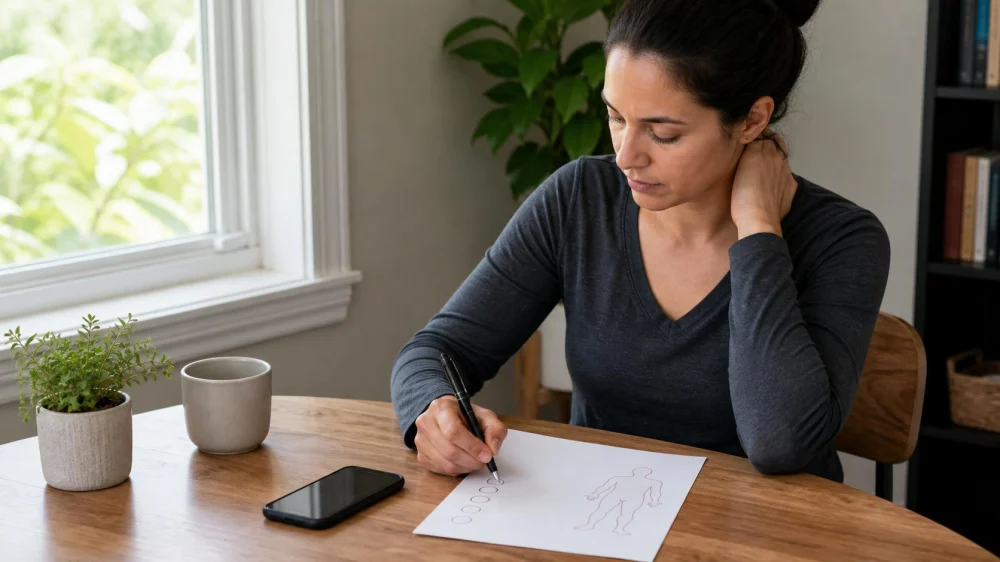
- Record the treated area, technique if known, symptom start time, intensity, location, and trend.
- Note new headache, dizziness, vision, speech, balance, strength, sensation, or coordination changes.
- Check for bowel or bladder changes, saddle-area numbness, fever, chest pain, or breathing difficulty.
- Avoid another manipulation or strenuous self-treatment when symptoms are unexplained or worsening.
- Contact the clinic promptly for persistent, increasing, or function-limiting discomfort.
- Use emergency services for sudden neurological symptoms, collapse, severe breathing problems, or severe pain.
- Share the visit date, technique, medication list, and symptom timeline with evaluating clinicians.
Step-by-step plan
- Before leaving, ask what reactions may occur, how long they should last, and whom to call after hours.
- Establish a baseline for pain, movement, strength, sensation, headache, and balance.
- If mild discomfort develops, follow provided advice and recheck whether function and intensity improve over hours.
- Write down new symptoms immediately instead of relying on memory, especially after neck treatment.
- Call the practitioner or a medical clinician when symptoms persist beyond the expected window or trend worse.
- Call 911 or seek emergency evaluation for sudden stroke-like, spinal-cord, severe headache, breathing, or collapse symptoms.
- Do not drive yourself when vision, balance, consciousness, strength, or coordination is impaired.
Record visit time, body region, known technique, immediate response, symptom onset, pain score, functional change, neurological symptoms, medicines, advice received, and each contact attempt. Keep the practitioner's information and bring the timeline to urgent or emergency care.
Limits and important notes
Symptom intensity alone does not identify the cause, and a rare event can begin with symptoms that seem nonspecific. Conversely, ordinary soreness cannot be diagnosed from a web article. Do not use hydration, stretching, heat, ice, or pain medicine unless consistent with your health history and professional instructions. Do not delay emergency care to obtain clinic permission.
Call 911 for sudden inability to speak, see, walk, or move; one-sided weakness or drooping; fainting; confusion; severe sudden headache; serious breathing difficulty; or suspected neck or spine injury with loss of feeling or movement. Urgent evaluation is also warranted for new bowel or bladder dysfunction, saddle numbness, progressive weakness, or rapidly escalating pain. Tell responders about the recent procedure.
Frequently asked questions
Is soreness after spinal manipulation common?
NCCIH reports transient mild-to-moderate discomfort, stiffness, or headache often occurs and usually resolves within 24 hours. Individual instructions and symptom trends still matter.
Should I schedule another adjustment for new severe symptoms?
No. New severe, neurological, or rapidly worsening symptoms need medical triage or emergency evaluation, not another manipulation.
Why record the exact symptom time?
Timing and progression help clinicians assess what happened, prioritize testing, and distinguish stable discomfort from a developing emergency.
Are serious complications impossible if I am healthy?
No procedure is risk-free. Serious events are reported as rare, but accurate individual prediction is not possible; assessment, informed consent, and prompt response remain important.
Sources and evidence
NCCIH's Spinal Manipulation: What You Need To Know describes common transient effects, rare reported serious events, possible added risk from underlying conditions, and the need to inform patients about potential cervical artery dissection. MedlinePlus emergency guidance identifies sudden speech, vision, walking, movement, weakness, fainting, severe headache, and spinal injury symptoms as reasons for emergency help.
Conclusion and next steps
Keep the after-hours number and establish a baseline before leaving the clinic. Track mild symptoms and their direction, but treat new neurological or severe changes as a medical-triage problem. For emergency signs, call 911, avoid driving, and give responders the procedure and symptom timeline.



 TriCounty Chiropractic and Rehabilitation of Exton4.0 (95 reviews)
 Dr. Ali Chiropractic and Wellness Center5.0 (54 reviews)
 THE SPORTS POD5.0 (120 reviews)
 Joyful Living Chiropractic and Wellness Center4.0 (69 reviews)
 GFCA Wellness Center, Chiropractic & Thermography5.0 (13 reviews)
 Jeanne Kennedy DC0.0 (0 reviews)
 How to Relieve Posture Correction Without Medication – Chiropractor Approved
 Chiropractic vs Physical Therapy: Which Is Better for Your Spine?
 Can Chiropractic Care Solve Your Chiropractic FAQ Problem?
 Chiropractic Care for Athletes: Boosting Performance and Preventing Injuries
 How Chiropractic Care Can Support Your Immune System Function
 Understanding the Connection Between Improving Mobility with Chiropractic Care and Your Spine