
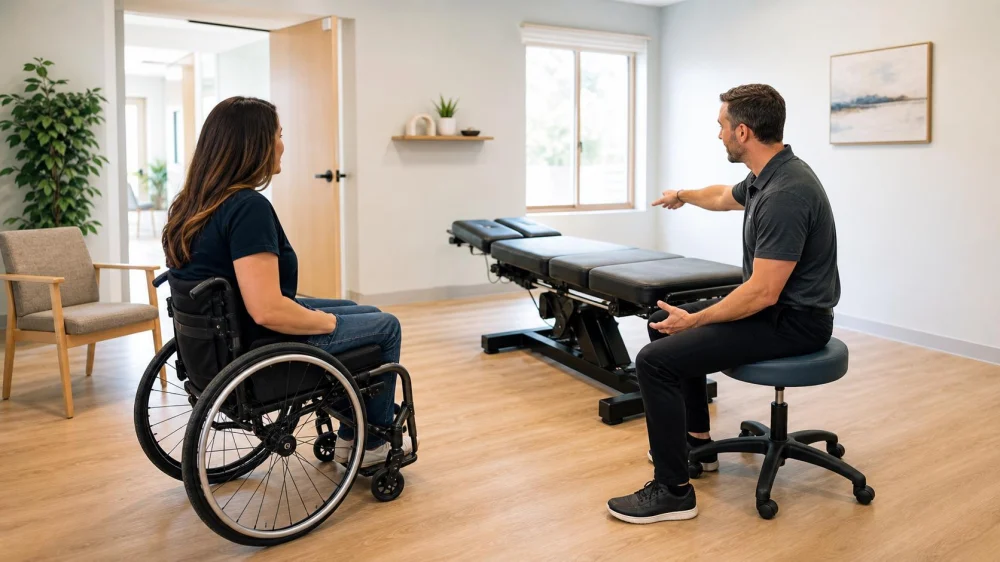
Questions to Ask About Chiropractic Clinic Accessibility
On this page
- Quick answer
- Define the access needs that matter
- Ask about arrival and building access
- Discuss the treatment space
- Plan communication and support
- Confirm arrangements before the visit
- Accessibility call checklist
- Limitations and important notes
- Frequently asked questions
- Sources and evidence notes
- Make a specific access request
Quick answer
Before booking, tell the chiropractic clinic the specific access tasks you need to complete: entering the building, parking or drop-off, moving through doorways, transferring to a table, communicating, and using the restroom. Ask for measurements or equipment details when they affect safety, and request confirmation from the person responsible for the visit. A general statement that a clinic is “accessible” may not answer your practical questions.
This guide is for people comparing chiropractic clinics in the United States. It offers appointment-planning questions, not legal advice or a determination that chiropractic care is suitable for a particular condition.
Define the access needs that matter
Accessibility is individual and task-specific. A ramp may solve one barrier while a narrow treatment room, fixed-height table, strong fragrance, or unavailable communication support creates another.
Write the top three requirements before calling. Examples include step-free entry, space for a mobility device, help with forms, a transfer method, a quieter waiting option, a support person, an interpreter process, or advance explanation before touch.
Describe the function rather than expecting staff to infer it from a diagnosis: “I need a stable way to transfer from my wheelchair without being lifted” gives the clinic a concrete planning question.
Ask about arrival and building access
- Is there a step-free route from parking or drop-off to reception?
- Where is the accessible entrance, and is it unlocked during the appointment?
- What are the doorway and elevator clearances when size matters?
- Are ramps, curb cuts, and hallways kept clear?
- Is accessible parking part of the property or managed elsewhere?
- Can the patient wait in another location if the reception area is crowded?
- Is an accessible restroom on the same route?
Ask about temporary conditions such as construction, snow, a broken elevator, or an alternate entrance. If transportation has strict timing, confirm where the driver can wait and whom to call on arrival.
Discuss the treatment space
Ask what type and height of examination or treatment table is planned and whether it adjusts. Explain any limits on lying prone, changing position, weight-bearing, balance, or transferring. Do not assume staff can lift a patient or that an accompanying person should do so.
Other useful questions include:
- Is there turning space for the mobility device in the room?
- Can the assessment be performed in an alternative safe position?
- Where can a cane, walker, wheelchair, service animal, or medical equipment remain?
- Are stable chairs with arms available?
- Can the clinician explain positioning before touching or moving equipment?
- What should the patient wear if changing clothes is difficult?
The clinician must decide which positions and procedures are clinically appropriate. Accessibility planning should not be confused with promising a particular treatment.
Plan communication and support
Tell the clinic how the patient communicates best and what support is needed for forms, hearing, vision, speech, cognition, language, or sensory processing. Ask how to request an interpreter or another communication aid and how much advance notice is required.
Clarify whether a support person may attend, what role that person has, and how the clinic preserves the patient's own consent and privacy. Bring assistive devices normally used for communication.
Agree on a pause signal before physical assessment. The patient should have a clear way to say that a position, touch, sound, or instruction needs to stop or be explained.
Confirm arrangements before the visit
Ask the office to document agreed arrangements in the appointment record. Request a short confirmation that states the entrance, room or equipment plan, arrival contact, and communication support. Reconfirm close to the visit when an elevator, specialized room, or staff member is essential.
Have a backup plan. If a lift, elevator, or adjustable table becomes unavailable, decide whether the clinic will reschedule, use another suitable room, or refer elsewhere. Do not improvise an unsafe transfer at the appointment.
Accessibility call checklist
- Name the exact arrival, movement, transfer, sensory, and communication needs.
- Verify the step-free route and accessible restroom.
- Ask about table adjustment, room space, and stable seating.
- Clarify service-animal, support-person, and interpreter procedures.
- Agree on touch explanations and a pause signal.
- Ask who owns the plan and how it will be documented.
- Confirm essential equipment shortly before the visit.
- Do not proceed with an unsafe transfer or inaccessible setup.
Limitations and important notes
- Online photos and directory labels may be outdated or omit interior barriers.
- Building access and clinical suitability are separate questions.
- Do not share more health information with scheduling staff than is needed to arrange the visit; complete clinical history through the clinic's appropriate process.
- Legal requirements and complaint processes depend on the setting and circumstances; use current official resources for legal questions.
- Urgent or emergency symptoms should be directed to the appropriate medical or emergency service rather than delayed for an accessibility comparison.
Frequently asked questions
Is an “ADA accessible” listing enough?
No single label describes every practical need. Verify the specific route, dimensions, equipment, restroom, communication, and transfer tasks that matter to you.
Can I ask for table measurements?
Yes, when height or width affects a safe transfer or position. Ask staff to obtain accurate information rather than estimate.
May a support person come into the room?
Ask the clinic. Policies can reflect space, privacy, infection control, and the patient's preference. Clarify the support person's role before the visit.
What if the clinic cannot meet an essential need?
Ask about a safe alternative, another location, rescheduling, or referral. Do not accept an improvised setup that creates a fall, transfer, or communication risk.
Should I visit the clinic before booking care?
A brief access check may help when logistics are complex and the clinic permits it. Confirm what can be inspected and avoid treating the visit as clinical advice.
Sources and evidence notes
The framework reflects broad accessible-service and patient-safety practice: define functional needs, verify the complete route, plan transfers and communication, document arrangements, and avoid unsafe improvisation. The clinic and current official accessibility resources provide setting-specific information.
Make a specific access request
Write one sentence for arrival, one for the treatment room, and one for communication. Call the clinic with those three requirements and ask staff to confirm the exact route and setup. If an essential answer is uncertain, request verification before scheduling transportation or committing to the visit.





 Peace of Health Chiropractic Wellness Clinic5.0 (8 reviews)
 Marc S. Rubenstein, DC5.0 (4 reviews)
 Jonihakis Chiropractic5.0 (66 reviews)
 The House of Chiropractic | Vitalistic Wellness Studio5.0 (42 reviews)
 New Jersey Total Health: Vincent G. Caruso, DC5.0 (26 reviews)
 Injury Docs Now St. James Chiropractic0.0 (0 reviews)
 How to Verify a Chiropractor's License and Credentials
 Best Chiropractic Treatments for Pinched Nerve According to Experts | ChiroScope
 Chiropractic for Runners: Treating IT Band Syndrome and Shin Splints Naturally
 The Truth About Sciatica Treatment: What Chiropractors Recommend for Effective Relief
 10 Things You Should Know About TMJ and Chiropractic
 10 Things You Should Know About Chiropractic FAQ