
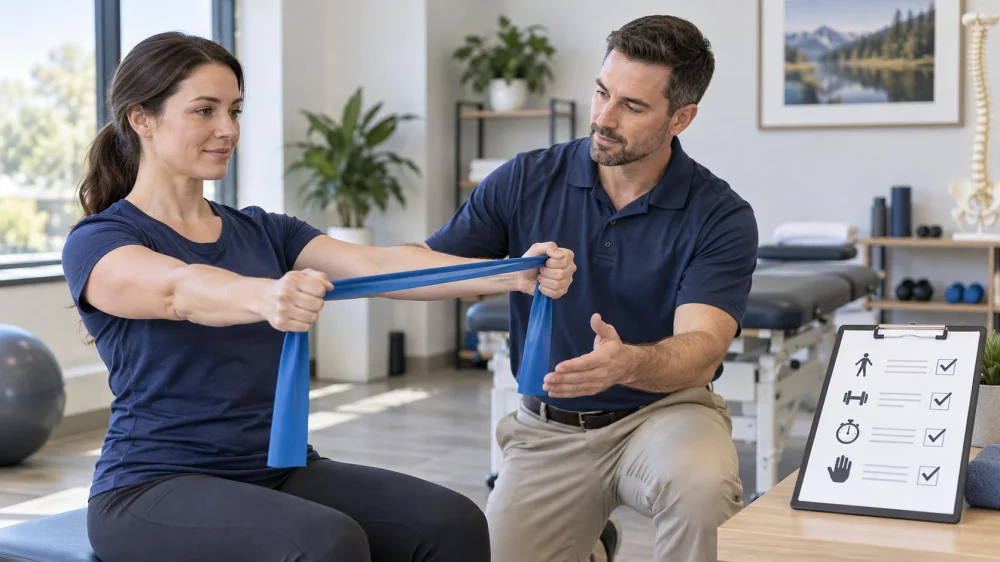
Chiropractic Exercise Instructions: Record Form, Dose, and Stop Rules
On this page
Quick answer
Before leaving the clinic, demonstrate each home exercise back to the clinician, record the exact starting position, repetitions, resistance, frequency, and stop rules, and ask how to report a problem. A useful plan is specific enough to follow without guessing and flexible enough to pause when symptoms change. “Do the stretch at home” is not a complete instruction.
Home exercise may be one part of a broader care plan. The National Center for Complementary and Integrative Health notes that studies of spinal manipulation sometimes compare or combine it with exercise and advice. That does not mean one routine fits every person. Your exercise plan should reflect your examination, goals, health history, and current symptoms.
Record the starting position
Write down the setup before recording the movement. Include where your feet, knees, hips, hands, and head should be, whether you sit or stand, and what equipment is used. If a towel, chair, wall, or resistance band matters, note its placement.
- Ask which joints should move and which should stay quiet.
- Record the intended direction and comfortable range.
- Ask what normal effort should feel like.
- Request a clinic-approved photo or handout when available.
Do not use an online video as a substitute unless the clinician confirms that it matches your prescribed version.
Define the exercise dose
Capture the full dose: repetitions, sets, hold time, rest time, resistance, and sessions per day or week. Ask whether to do the exercise on treatment days and what to do after a missed session. Avoid “making up” repetitions unless your clinician specifically directs it.
Write a starting dose and a progression rule separately. For example, an increase might depend on completing the current dose with acceptable form and no concerning response. A calendar date alone is not always enough reason to increase.
Use a teach-back demonstration
Perform the exercise while the clinician watches, then explain the instructions in your own words. This is not a test of you; it is a check that the explanation was clear. Ask the clinician to correct one detail at a time, then repeat the movement.
If someone will help you at home, ask whether that person should attend the demonstration. Do not improvise hands-on assistance, traction, or force that was not explicitly taught.
Set stop and call rules
Ask what sensations are expected, what means “reduce or pause,” and what requires prompt medical attention. Stop the exercise and seek urgent care for emergency symptoms such as new severe weakness, loss of bladder or bowel control, fainting, chest pain, trouble breathing, or signs of stroke. Local emergency guidance takes priority over a home program.
For nonemergency changes—such as steadily increasing pain, persistent numbness, dizziness, or a new symptom—pause and contact the appropriate clinician for individualized advice. Do not push through a symptom merely to complete a target number.
Track your response simply
A short log is usually more useful than a long diary. Record the date, exercise and dose, symptom response during the activity, and how you felt later that day or the next morning. Note changes in function, such as walking, sleep, work, or lifting, instead of recording pain alone.
Bring the log to follow-up visits. It can help the clinician decide whether to continue, simplify, progress, or replace an exercise.
Avoid common instruction errors
- Do not add weight, speed, or range without an agreed progression rule.
- Do not combine similar routines from several providers without telling them.
- Do not copy another patient’s program.
- Do not continue when equipment is damaged or unstable.
- Do not treat a generic handout as a diagnosis.
Share relevant medical conditions, recent injuries, pregnancy, medicines, and prior procedures with the practitioner. NCCIH specifically advises discussing health problems because they may affect the risks of spinal manipulation and related care.
Questions to ask before leaving
- Can you watch me perform one complete set?
- What should I feel, and where should I feel it?
- What is my exact starting dose?
- When may I progress, and what should remain unchanged?
- Which symptoms mean reduce, stop, call, or seek urgent care?
- How should I contact the clinic if the instructions are unclear?
Evidence note: This guide uses patient-safety information from the U.S. National Center for Complementary and Integrative Health, including Spinal Manipulation: What You Need To Know. It is a planning checklist, not a diagnosis or a personalized exercise prescription.






 Sunset Chiropractic5.0 (114 reviews)
 Tarlow Chiropractic & Wellness4.0 (16 reviews)
 Restoration Health4.0 (90 reviews)
 Firefly Chiropractic5.0 (21 reviews)
 Vibrant Life Chiropractic4.0 (59 reviews)
 Higher Health Chiropractic & Rehabilitation5.0 (276 reviews)
 How Chiropractic Helps with Stress, Pain, and Healing | ChiroScope
 How Often Should You Visit a Chiropractor? Recommendations and Benefits
 Chiropractic Visit With a Mobility Aid: Plan the Setup
 Chiropractic Advice for Sciatica Treatment | Tips You Can Start Today
 Understanding the Connection Between Ergonomics and Spinal Health and Your Spine
 Chiropractic Care for Stress Management: Techniques and Benefits