
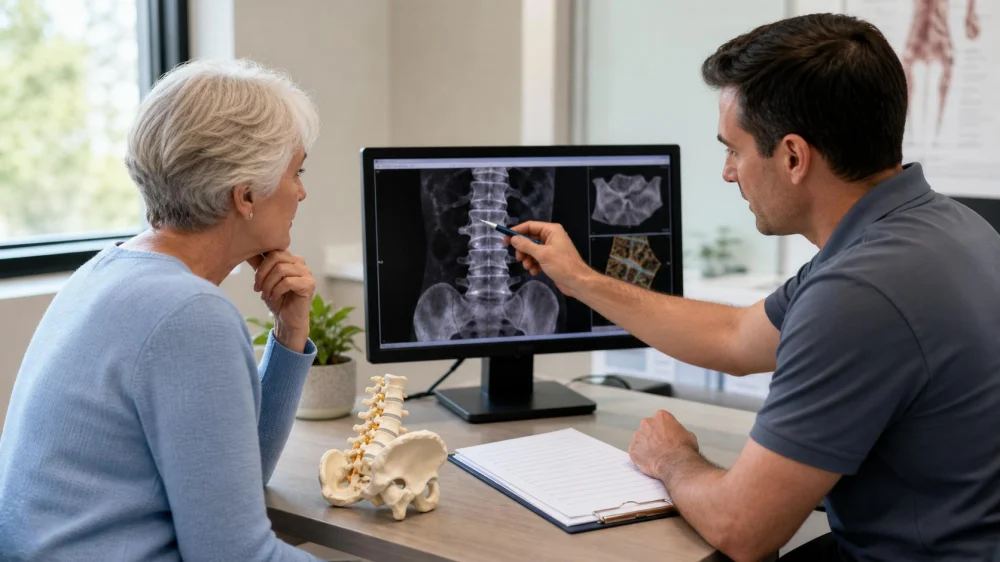
Osteoporosis and Chiropractic Care: Confirm Fracture Risk
Table of contents
Quick answer
If you have osteoporosis, low bone density, a prior fragility fracture, or unexplained loss of height, tell both your medical clinician and chiropractor before any manual treatment. Ask whether further assessment is needed and how the proposed technique accounts for fracture risk. Do not assume a gentler-sounding method is automatically appropriate. New severe back pain or symptoms after a minor fall need medical evaluation before routine care.
Why fracture risk matters
The National Institute of Arthritis and Musculoskeletal and Skin Diseases describes osteoporosis as reduced bone strength that increases fracture risk. It is often silent until a bone breaks. Fractures commonly affect the hip, wrist, and vertebrae, and fragile bones may fracture after a low-level fall or even normal stresses such as bending, lifting, or coughing.
Spinal manipulation applies controlled force to a spinal joint. The National Center for Complementary and Integrative Health states that underlying health problems can increase the likelihood of serious side effects and that practitioners should assess patients thoroughly. These points make bone health a pre-treatment safety issue, not a detail to mention afterward.
Before booking care
- Confirm the diagnosis. Know whether you have osteoporosis, osteopenia, a prior fragility fracture, or only a concern awaiting testing.
- Contact your treating clinician. Ask whether the new pain or planned manual care needs medical review first.
- Verify the chiropractor. Check current state licensure and the clinic’s experience coordinating care for people with low bone density.
- Request the proposed approach. Ask what body region and technique would be considered, without agreeing before evaluation.
- Bring records. Include relevant imaging reports, bone-density results, fracture history, and medication list.
Information to share
- Osteoporosis or osteopenia diagnosis and date
- DXA results and which sites were measured, if available
- Previous spine, hip, wrist, rib, or other low-trauma fractures
- Recent falls, sudden pain, loss of height, or posture change
- Cancer, infection, steroid use, endocrine disorders, or other bone-risk conditions
- All medicines and supplements, including osteoporosis treatment and blood thinners
- Prior spine surgery, implants, and current medical restrictions
Do not stop a prescribed osteoporosis medicine or change activity limits for a chiropractic visit unless the prescribing clinician directs it.
Questions for the visit
- What diagnosis or working explanation supports this care?
- Could my symptoms represent a fracture that needs medical imaging?
- What force and movement would the proposed technique use?
- How will my fracture risk change the plan?
- What alternatives avoid thrust or loading of vulnerable areas?
- What benefits are realistic, and what evidence supports them?
- What mild effects are expected, and which symptoms mean stop or seek help?
- Will you coordinate with my physician, osteoporosis specialist, or physical therapist?
Symptoms needing medical assessment
NIAMS notes that vertebral fracture symptoms can include severe back pain, height loss, or a stooped or hunched spinal shape. Because osteoporosis may be silent, new focal pain after a small fall, lift, cough, or twist should not be dismissed. Medical assessment may determine whether imaging or another test is appropriate.
Do not use short-term pain relief as proof that a fracture is absent. Likewise, an X-ray taken for another purpose does not automatically replace a clinician-directed osteoporosis evaluation or DXA bone-density test.
Coordinate the care plan
Ask each provider to define their role. The medical team diagnoses and treats osteoporosis and evaluates suspected fractures. A chiropractor should know those findings before recommending manual care. A physical therapist or other clinician may help design balance, strength, and fall-prevention work tailored to the person’s condition.
Request a written visit summary that names the technique used, response, home advice, and follow-up plan. Share relevant updates with the clinicians managing bone health.
Visit checklist
- Current medication and supplement list
- DXA and imaging reports, not just image files
- Fracture, fall, surgery, and cancer history
- Description and timeline of current pain
- Medical restrictions and provider contact information
- Written questions about force, alternatives, stop rules, and coordination
- Plan for safe transportation if movement is painful
Limitations and emergency signs
This article cannot establish fracture risk, diagnose a fracture, or approve spinal manipulation. Call emergency services for new paralysis, loss of bladder or bowel control, severe weakness, collapse, chest pain, or stroke signs such as facial droop, arm weakness, or speech difficulty. Seek prompt medical care for severe new back or neck pain, pain after a fall, new numbness, fever, unexplained weight loss, or rapidly worsening symptoms. Do not delay medical evaluation to attend a routine manual-care visit.
Frequently asked questions
Does osteoporosis always cause pain?
No. NIAMS calls it a silent disease because symptoms often do not appear until a fracture occurs.
Can a chiropractor diagnose osteoporosis from posture?
Posture may prompt concern, but osteoporosis diagnosis requires medical evaluation. NIAMS identifies DXA at the hip and spine as the usual reliable bone-density test.
Is spinal mobilization the same as manipulation?
No. NCCIH distinguishes mobilization, which stays within natural range without a thrust, from manipulation, which applies a controlled thrust. Suitability still requires individual assessment.
Should I bring my bone-density report?
Yes. Bring the report and discuss its meaning with the clinician who manages your bone health; a single score should not be interpreted in isolation.
Official sources
See NCCIH’s Spinal Manipulation: What You Need To Know for technique, evidence, side effects, and assessment guidance. NIAMS provides official information on osteoporosis and diagnosis, treatment, and steps to take, including fracture symptoms and DXA testing.
Next steps
Gather your bone-health records, tell every provider about fracture risk, and ask the medical clinician managing your osteoporosis whether new symptoms need assessment. Consider manual care only after a licensed practitioner reviews the relevant history and explains an individualized risk-aware plan.






 Campbellsburg Chiropractic4.0 (113 reviews)
 Marcum Chiropractic Clinic5.0 (270 reviews)
 Concord Chiropractic5.0 (34 reviews)
 Family Tree Chiropractic & Wellness4.0 (70 reviews)
 Genesis Life Wellness4.0 (28 reviews)
 W A. Forwood, DC3.0 (2 reviews)
 Headache Before Chiropractic Care: When to Seek Help
 How Chiropractic Care Can Solve Your Sleep and Posture Problems
 The Role of Chiropractic Care in Managing Digestive Disorders
 The Role of Chiropractic Care in Managing Temporomandibular Joint (TMJ) Disorders
 Best Chiropractic Treatments for Migraines: How Chiropractors Treat Migraines According to Experts
 Is Herniated Disc Care Affecting Your Daily Life? Here's How a Chiropractor Can Help