
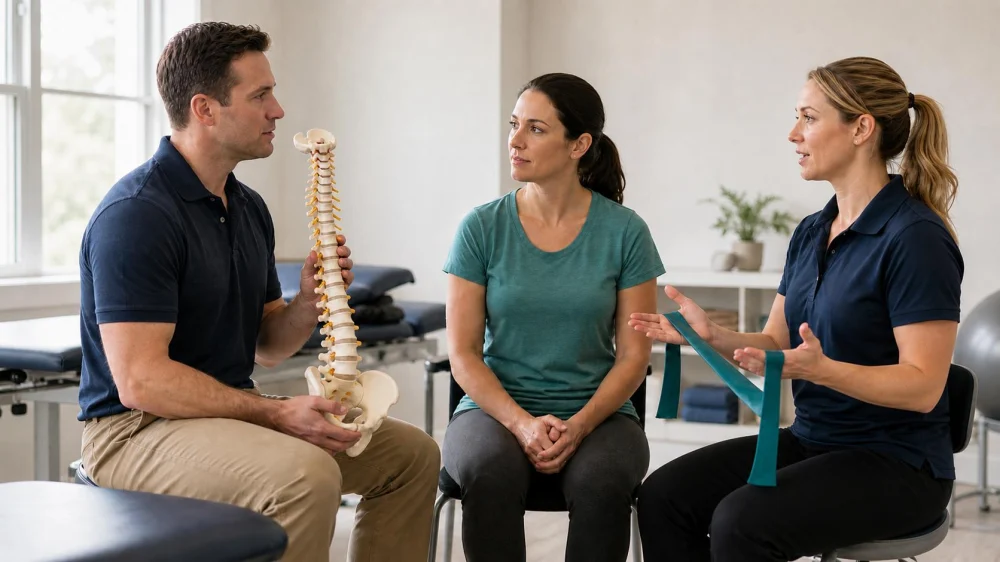
Chiropractic vs. Physical Therapy: Compare Roles and Plans
On this page
- Quick answer
- How the professional roles differ
- Where care may overlap
- Compare the evaluation
- Compare the treatment plan
- Match the clinician to the goal
- When coordinated care may help
- Verify credentials, scope, and coverage
- Limitations and urgent-care boundaries
- Frequently asked questions
- Sources and evidence notes
- Conclusion and next steps
Quick answer
Chiropractors and physical therapists both evaluate movement-related problems and may use education, exercise, and hands-on care, but their training, licenses, scope, and typical emphasis differ. Choose based on the condition, need for medical diagnosis or referral, functional goal, preferred treatment approach, clinician experience, and measurable plan. Neither profession is automatically the right choice for every back, neck, or joint problem.
This guide is for adults comparing licensed outpatient care in the United States. State rules, referral requirements, insurance coverage, and individual clinician skills vary.
How the professional roles differ
A chiropractor is a licensed clinician trained in chiropractic diagnosis and care, commonly with an emphasis on musculoskeletal conditions and manual procedures, including spinal or joint manipulation and mobilization. Scope and permitted services depend on state law.
A physical therapist is a licensed rehabilitation clinician trained to evaluate movement and function and to use exercise, education, neuromuscular and functional training, and selected hands-on or physical interventions. Physical therapists work in outpatient, hospital, home, school, sports, neurologic, cardiopulmonary, and other settings.
Titles do not reveal a clinician’s exact specialty. One chiropractor may emphasize exercise and self-management; another may emphasize manipulation. One physical therapist may focus on orthopedic rehabilitation; another may specialize in balance, pelvic health, neurologic recovery, or postoperative care.
Where care may overlap
Both professions may:
- take a history and perform a musculoskeletal or movement examination;
- screen for findings that require medical referral;
- provide education about activity, load, posture, and self-management;
- prescribe or supervise exercise within scope;
- use mobilization, soft-tissue approaches, or other manual techniques;
- set functional goals and track progress;
- coordinate with physicians and other healthcare professionals.
The presence of overlap does not make the services interchangeable. Ask what the individual clinician actually does for the specific condition.
Compare the evaluation
A useful evaluation should connect symptoms with function and screen for serious causes. Ask whether it will include neurologic checks, movement and strength assessment, relevant vital signs, prior imaging or surgery review, medication and health history, and red-flag screening.
Compare these questions:
- What is the working diagnosis or classification?
- What findings support it, and what remains uncertain?
- Does the clinician need records, imaging, or medical consultation?
- Which activities and functions will be measured?
- What would make the clinician refer or stop treatment?
A brief symptom description followed by a preset treatment should not replace an appropriate assessment.
Compare the treatment plan
Request a plan that identifies interventions, home practice, visit frequency, expected review date, and exit criteria. Ask how passive care supports—not replaces—active recovery when exercise and activity are appropriate.
Useful plan elements include:
- one or two meaningful functional goals;
- a baseline measure that can be repeated;
- clear explanation of each treatment’s purpose;
- alternatives and the option to decline a procedure;
- a manageable home program with form and stop rules;
- a defined reassessment point;
- a discharge, self-management, or referral plan.
Match the clinician to the goal
Consider a physical therapist when the primary goal is structured rehabilitation after surgery or injury, gait or balance training, return to work or sport, progressive strength and endurance, or a specialty such as neurologic or pelvic health care.
Consider a chiropractor when the goal is evaluation of a musculoskeletal complaint and the patient wants a clinician whose practice includes chiropractic manual care, provided screening, consent, exercise, and follow-up fit the condition.
Start with medical evaluation when symptoms suggest fracture, infection, serious neurologic compromise, vascular problems, inflammatory disease, cancer, or another condition outside routine outpatient manual care. The safest first clinician may be determined by urgency rather than preference.
When coordinated care may help
Using both professions is not automatically more comprehensive. It may help when roles are distinct and communication prevents duplication—for example, one clinician manages a specific manual intervention while another supervises postoperative or sport-specific rehabilitation with the surgeon’s plan.
Before combining care:
- tell each clinician about the other;
- share diagnoses, restrictions, imaging, and current exercises;
- identify who coordinates the overall plan;
- avoid conflicting load or treatment on the same day unless intentionally planned;
- agree on the outcome each service owns;
- reassess whether both remain necessary.
Verify credentials, scope, and coverage
- Check the active professional license through the state authority.
- Ask about experience with the specific condition, age group, and goal.
- Verify whether a referral is required by state law, insurance, or the clinician’s policy.
- Confirm network status, deductible, copay or coinsurance, visit limits, authorization, and billing codes.
- Review cancellation, records, privacy, consent, and complaint procedures.
- Ask who covers urgent questions and how records reach the medical team.
Credentials or testimonials do not guarantee a result. Look for transparent scope, evidence-aware recommendations, and willingness to refer.
Limitations and urgent-care boundaries
Evidence and recommended care vary by diagnosis. Neither chiropractic nor physical therapy should delay emergency evaluation. Seek urgent help for new severe weakness, stroke-like symptoms, loss of bowel or bladder control with neurologic changes, major trauma, chest pain, severe breathing difficulty, fever with severe spinal pain, or rapidly worsening symptoms.
Persistent pain, numbness, unexplained weight change, nighttime symptoms, or failure to improve at the planned review point deserves reassessment. A new diagnosis may change which profession or setting is appropriate.
Frequently asked questions
Do physical therapists perform spinal manipulation?
Some do within state scope and training, while others do not. Ask the individual clinician and verify jurisdictional rules.
Do chiropractors prescribe exercise?
Many do within scope, but the amount and quality vary. Ask to see the exercise and progression plan.
Can I see both at the same time?
Possibly, but define separate goals, share records, and avoid duplicated or conflicting care. More visits are not automatically better.
Which is better for back pain?
The answer depends on cause, severity, goals, preferences, clinician quality, and the specific plan. Seek appropriate diagnosis and compare measurable approaches rather than profession labels alone.
Sources and evidence notes
This guide reflects broad United States professional practice: chiropractic and physical therapy overlap in musculoskeletal assessment, exercise, education, and some manual care, while training pathways and scopes differ. Condition-specific evidence and state rules determine appropriate services.
Conclusion and next steps
Define the function you want to regain, identify any diagnosis or medical-screening need, and interview the actual clinician rather than choosing by title alone. Compare the evaluation, active-care plan, manual techniques, review date, exit criteria, license, and coverage. Use coordinated care only when each professional has a clear nonduplicative role.






 The Head & Spine Pain Center5.0 (273 reviews)
 King Chiropractic4.0 (33 reviews)
 Willow Haus Chiropractic | New Braunfels Pediatric & Pregnancy Chiropractor5.0 (39 reviews)
 Riverdale Wellness and Rehab4.0 (39 reviews)
 Mendoza Chiropractic5.0 (31 reviews)
 Revolution Chiropractic4.0 (177 reviews)
 Chiropractic for Firefighters with Lumbar Spine Injuries and Heat-Related Muscle Fatigue
 Chiropractic Solutions for Sciatica: Alleviating Leg Pain Through Spinal Care
 How Chiropractic Care Supports Pregnancy: Safe and Effective Techniques
 How Chiropractic Adjustments Improve Performance for Athletes
 Chiropractic Care for Managing Post-Concussion Syndrome | Effective Treatment Options
 How Chiropractic Adjustments Help Prevent Chronic Pain and Injury