
Chiropractic Home Exercises: Clarify the Plan and Stop Signs
On this page
Quick answer
Before doing chiropractic home exercises, get the exact movement, purpose, starting position, range, repetitions or time, frequency, breathing, expected response, progression rule, and stop signs in writing. Demonstrate the exercise back to the clinician. Start at the prescribed level, track function and symptoms, and pause for new or worsening pain, numbness, weakness, dizziness, loss of balance, or unclear technique.
This article helps U.S. adults organize an exercise plan prescribed after clinical assessment. It does not prescribe exercises or determine whether a movement is safe for a particular diagnosis, injury, surgery, pregnancy, or medical condition.
Make the plan individual
A generic label such as “core work,” “neck stretch,” or “posture exercise” is not a complete plan. Ask what problem or functional goal the movement addresses and why it fits your examination, health history, current symptoms, and activities.
Confirm the starting position, body region that should move, body region that should stay stable, equipment, surface, and space. Ask whether the exercise changes on a flare day, after treatment, before work, or when another activity already loads the same area.
Review previous surgery, fracture risk, cardiovascular concerns, pregnancy, neurologic symptoms, hypermobility, balance problems, medication effects, and other relevant conditions. The clinician should coordinate or refer when the plan exceeds their scope.
Clarify dose, technique, and progression
Write down sets, repetitions, hold time, rest, days per week, and intended effort. “Do it often” can lead to too little practice or excessive volume. Ask how the plan fits work, sport, rehabilitation, and other prescribed exercise.
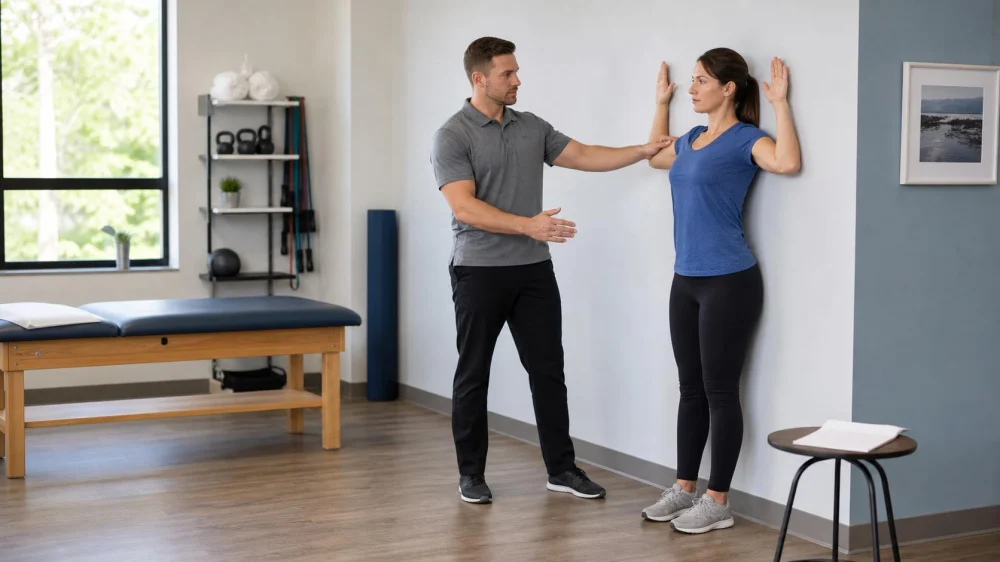
Have the clinician watch you perform several controlled repetitions. Use a mirror or video only if it improves feedback safely and recording is permitted. Ask for one or two technique cues rather than a long list you cannot reproduce.
Progression should have a rule: more range, resistance, repetitions, time, balance challenge, or task complexity after a defined response. Do not increase several variables at once. Ask what to do if the exercise becomes too easy, too difficult, or repeatedly irritating.
Track response and function
Record the exercise, dose, immediate response, later response, and one functional measure such as sitting tolerance, walking distance, sleep, lifting, or turning. A simple log helps separate one difficult day from a consistent pattern.
Ask what mild sensations may be expected and how long they should last. Do not accept vague advice to push through every symptom. Pain intensity alone is incomplete; location, quality, spread, timing, weakness, sensation changes, and function matter.
Bring the log and demonstrate again at reassessment. If the exercise is not feasible in your home, schedule, clothing, floor, or equipment, ask for an equivalent option instead of improvising.
Home-exercise checklist
- Name the goal. Connect the exercise to a specific function or symptom pattern.
- Confirm the setup. Record position, surface, equipment, support, space, and footwear.
- Write the dose. Include repetitions or time, sets, rest, frequency, and effort.
- Demonstrate back. Let the clinician correct your actual movement before you leave.
- Define the expected response. Know which sensations and recovery window are acceptable.
- List stop signs. Put urgent and non-urgent contact instructions in the plan.
- Set a progression rule. Change one variable only after the agreed criteria are met.
- Book reassessment. Decide when function, technique, and the ongoing need for the exercise will be reviewed.
Stop signs and contact triggers
Stop the exercise and contact the prescribing clinic for new or worsening pain, spreading symptoms, numbness, tingling, weakness, dizziness, headache, loss of balance, unusual shortness of breath, chest symptoms, or a response outside the agreed range.
Also pause when you cannot reproduce the setup, equipment slips, the floor is unsafe, fatigue changes control, or the written and demonstrated instructions conflict. Do not add weight, force, speed, end-range stretching, or neck manipulation to “make it work.”
If symptoms are mild but repeatedly last longer than expected, document timing and dose rather than continuing unchanged. The correct response may be lower dose, different technique, reassessment, or referral—not necessarily more effort.
Medical-triage limits
- Seek emergency help for chest pain, severe breathing difficulty, stroke-like symptoms, fainting, major trauma, sudden severe headache, or other emergency signs.
- New bladder or bowel change, saddle numbness, progressive weakness, or severe coordination loss requires urgent medical assessment.
- Fever, unexplained weight loss, cancer history, infection risk, or fracture risk with new back or neck symptoms needs appropriate medical triage.
- Do not use home exercise to delay evaluation of rapidly worsening or unexplained symptoms.
- Online exercise demonstrations do not override an individual plan or provide a diagnosis.
- Exercise plans should be coordinated when multiple clinicians prescribe overlapping or conflicting activities.
Frequently asked questions
Should an exercise hurt to be effective?
Not as a general rule. Ask what response is expected for your plan. New, sharp, spreading, or worsening symptoms should not be treated as proof of progress.
What if I forget the correct position?
Pause and use the approved written or video instruction, or contact the clinic. Do not guess at a loaded or end-range movement.
Can I do more repetitions on a good day?
Only within the agreed progression rule. Sudden increases can obscure which dose your body tolerated.
How long should I keep doing the exercise?
The plan should have a review point and goal. Some exercises progress, some become maintenance, and some should stop when the reason for them changes.
Can I combine the plan with online workouts?
Ask the prescribing clinician how other training affects load and recovery. Avoid duplicating or contradicting the target without review.
Sources and evidence notes
This article reflects broad rehabilitation and motor-learning practice: individualized goals, clear dosage, observed technique, graded progression, symptom and function tracking, and defined stop or referral criteria.
Use the prescribing clinician's written plan, relevant medical advice, equipment instructions, and coordinated guidance from involved healthcare professionals.
Conclusion and next steps
Leave the clinic able to teach the exercise back: why you are doing it, how to set up, how much to do, what should change, and when to stop. Track one functional outcome and the response over time, then bring that evidence to reassessment. A useful home plan is specific enough to follow and flexible enough to change when the clinical picture changes.



 Hoboken Family Chiropractic + Wellness4.0 (97 reviews)
 Calvin W. Plumb, DC4.0 (55 reviews)
 The Joint Chiropractic5.0 (215 reviews)
 Provision Chiropractic5.0 (84 reviews)
 Dr. Jennifer Escarcega DC5.0 (7 reviews)
 Dr. Aryan Dibagohar D.C.0.0 (0 reviews)
 How Chiropractic Treatment Can Help With Stress-Induced Conditions
 Understanding the Connection Between Sciatica Treatment and Your Spine
 Expert Tips for Managing Chiropractic vs Physical Therapy Naturally with Chiropractic Care
 Expert Tips for Managing Posture Correction Naturally with Chiropractic Care
 The Science Behind Chiropractic Care: How It Promotes Healing and Wellness
 Chiropractic Care for Enhancing Flexibility and Mobility – A Guide to Improving Movement