
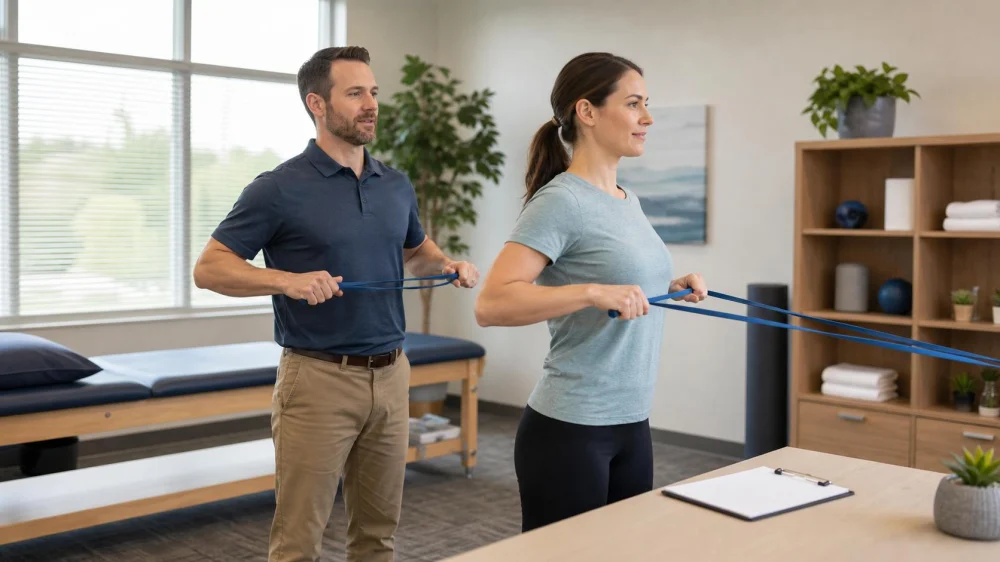
Chiropractic Home Exercises: Confirm Form and Stop Rules
On this page
Quick answer
Before doing a chiropractic home exercise, confirm its goal, starting position, movement, range, repetitions, frequency, breathing, expected sensation, and stop rules. Demonstrate it back to the clinician instead of relying on memory. At home, use stable space and controlled movement. Stop and seek appropriate care for new weakness, numbness, severe pain, or other warning signs.
Define the purpose of each exercise
A home exercise is a movement assigned for practice outside the clinic to support a defined care goal. It may address mobility, strength, control, tolerance, or activity habits. The exercise name alone is not enough because variations can target different tissues and use different ranges.
Ask what the exercise is intended to change and how that connects to your assessment. Also ask when it may not apply, especially after a new injury, surgery, diagnosis, medication change, pregnancy, or change in neurologic symptoms.
Confirm the complete instructions
- Ask the clinician to demonstrate at normal and slow speed.
- Perform one repetition while the clinician watches.
- Confirm starting position, direction, range, tempo, breathing, repetitions, sets, and days.
- Ask what mild effort or stretch is expected and what sensation is not.
- Request a written or clinic-approved video reference when available.
- Ask how to modify or pause the exercise during a symptom flare.
- Clarify the date or milestone for review.
Photograph or record a demonstration only with permission and without capturing other patients. A generic online video may show a different variation and should not override individual instructions.
Practice safely at home
Choose a clear area with stable flooring, enough space, and a firm support if prescribed. Keep children, pets, cords, and loose objects away. Use the specified chair, band, towel, or other equipment and inspect it before every session.
Warm up only as directed. Move within the assigned range without bouncing, forcing, or adding weight. Breathe normally unless given a specific pattern. Quality is more useful than finishing a number with poor control.
Keep a brief log of the exercise, dose, symptoms before and after, and function later that day. Do not repeatedly provoke pain to “test” progress.
Use clear stop and escalation rules
Stop the exercise and contact the treating clinician for unexpected or increasing pain, new tingling or numbness, weakness, loss of coordination, dizziness, faintness, severe headache, chest pain, shortness of breath, or symptoms outside the agreed response.
Emergency symptoms—including new bowel or bladder control problems, numbness in the saddle region, signs of stroke, major trauma, or rapidly progressing weakness—need urgent medical evaluation rather than another exercise session. Use emergency services when appropriate.
Report progress at follow-up
Bring the log and describe what changed in daily tasks, sleep, walking, work, or exercise. Report exercises skipped and why. A clinician may keep, progress, regress, replace, or stop an exercise based on response.
Coordinate the plan with relevant medical, physical therapy, or rehabilitation professionals. Share restrictions and avoid duplicate or conflicting programs. When comparing chiropractors in the United States, verify state licensure, ask how home exercise is assessed and reviewed, and confirm referral procedures. A directory listing is only a starting point.
Home-exercise checklist
- Know the goal and exact variation
- Demonstrate the movement back in clinic
- Confirm dose, breathing, expected sensation, and stop rules
- Use clear space and inspected equipment
- Move with control rather than force
- Track response and daily function
- Review the program on a defined date
- Escalate neurologic or emergency warning signs
Limitations and important notes
This article cannot select an exercise, diagnose pain, or determine a safe range. Age, balance, bone health, surgery, cardiovascular conditions, pregnancy, neurologic disease, and medication may change the plan.
Do not add self-manipulation, another person’s pressure, or improvised weights to a prescribed movement. If instructions are unclear, pause and ask rather than guessing.
Sources and evidence notes
The approach follows broad rehabilitation practice: connect exercise to an assessment, teach and verify form, specify dosage and stop rules, monitor function, and review the program. The treating licensed clinician’s individualized instructions are the relevant source; no universal exercise or outcome is claimed.
Frequently asked questions
Should an exercise hurt to be effective?
No universal pain rule applies. Ask what sensation is expected for your condition and stop outside that boundary. Sharp, severe, spreading, or neurologic symptoms need review.
Can I do extra repetitions on a good day?
Not without agreement. More dose can change tissue load and symptoms. Follow the plan until the clinician progresses it.
What if I forget the form?
Pause and request clarification or an approved reference. Do not substitute a same-named online exercise that may use a different technique.
How soon should the exercise help?
There is no universal timeline. Track function and symptoms, then review them at the agreed follow-up or sooner if the response is concerning.
Conclusion and next steps
Turn every home exercise into a complete instruction set: purpose, position, movement, dose, expected response, stop rules, and review date. Demonstrate it before leaving, practice in a safe space, and record the response. New neurologic or emergency symptoms require appropriate medical care, not persistence.


 Chiroseattle - Tuttle DeLucchi Chiropractic4.0 (287 reviews)
 T Bar M Athletic5.0 (2 reviews)
 SMART Medical and Rehab Therapy - Silver Spring4.0 (43 reviews)
 Eshelman Chiropractic5.0 (26 reviews)
 Vitality Health New York5.0 (1 reviews)
 Bynum Chiropractic5.0 (284 reviews)
 Understanding How Chiropractors Treat Migraines: Effective Solutions
 The Link Between Chiropractic Care and Better Sleep Quality: How Chiropractic Treatments Can Improve Your Sleep
 Understanding the Connection Between TMJ, Chiropractic, and Your Spine
 My Experience with Chiropractic for Chronic Myofascial Pain Syndrome
 Everything You Need to Know About Natural Pain Management from a Chiropractic Perspective
 Expert Tips for Managing Chiropractic for Headaches Naturally