
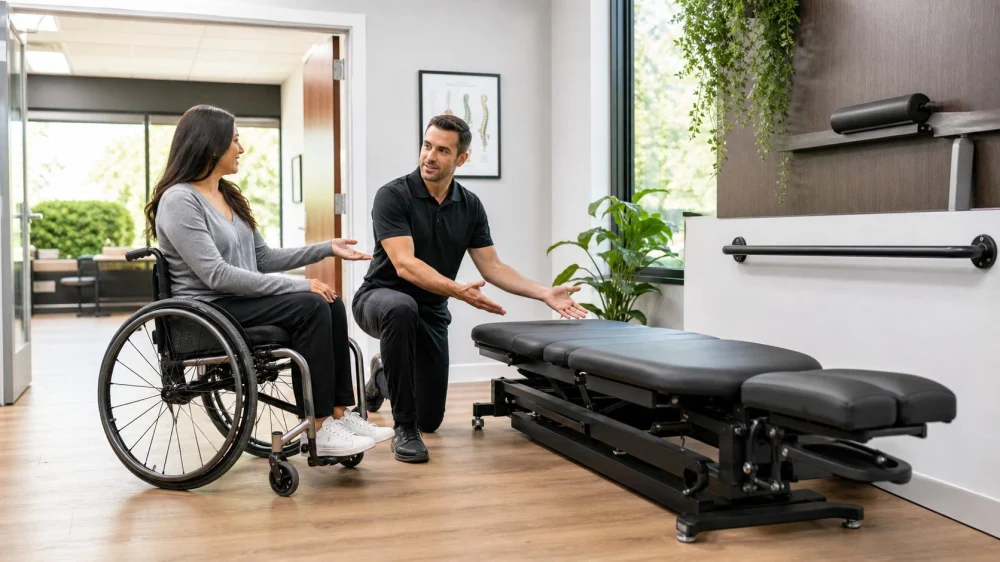
Chiropractic Clinic Accessibility: Plan Entry and Positioning
On this page
Quick answer
Before a chiropractic visit, describe your mobility, transfer, positioning, communication, sensory, and assistance needs to the exact clinic. Confirm the route from parking or transit to reception and the treatment room, the table's lowest height and supports, clear floor space for your device, trained staff assistance, and an alternative plan. Do not attempt an unsafe transfer or accept treatment in a position you cannot maintain.
This guide is for United States patients planning access to a chiropractic clinic. It offers practical questions, not legal advice or a guarantee that a clinic can provide a particular treatment. ADA requirements, building conditions, equipment, professional scope, and individual clinical needs vary.
Describe needs before booking
Use functional details rather than only a diagnosis. The scheduler needs to know what the visit requires:
- Wheelchair, scooter, walker, cane, prosthesis, service animal, or other mobility device
- Preferred transfer side and whether you transfer independently, with a board, with staff assistance, or with a lift
- Ability to lie prone, supine, side-lying, seated, or only in a supported position
- Need for extra time, a quiet waiting option, an accessible restroom, a caregiver, interpreter, captioning, or other communication support
- Height, width, weight-capacity, pressure-relief, or positioning needs relevant to equipment
- Fall risk, dizziness, pain with movement, spasticity, weakness, recent surgery, skin risk, or medical-device considerations
Ask the staff to repeat what it recorded and note it for future appointments. A general statement such as “wheelchair accessible” may describe the entrance but not the treatment room, table, transfer equipment, restroom, or staff preparation.
Check the full entry route
- Arrival: confirm accessible parking or drop-off, curb cuts, surface slope and condition, transit distance, and weather exposure.
- Building entrance: ask about steps, ramps, door width, door force or automatic opening, thresholds, intercom, and locked-entry process.
- Interior route: verify elevator size and operation, hallway turns, rugs, furniture, and whether the mobility device can reach reception and the treatment room.
- Waiting area: ask for a clear space where the device does not block a route and seating that supports transfers if needed.
- Restroom: confirm location, route, door, turning space, grab bars, sink, and whether it meets your actual needs.
- Emergency exit: ask how the clinic assists patients who cannot use stairs or independently evacuate.
Request recent photos or a live video walkthrough when details are uncertain. An online photo may be outdated or omit a threshold, narrow turn, or temporary obstruction.
Ask about room and table access
ADA.gov guidance for medical care describes adjustable-height tables, clear approach space, support rails, positioning aids, transfer boards, lifts, and trained assistance as examples that can make health-care equipment usable for people with mobility disabilities. A chiropractic table has its own shape and moving sections, so verify the exact table reserved for the appointment.
- What is the table's lowest transfer height, surface width, and rated capacity?
- Can it remain stable at transfer height, and which sections move before or during care?
- Is there clear floor space on the transfer side and room for a wheelchair, lift, or caregiver?
- Are removable rails, handles, wedges, bolsters, pillows, straps, or other supports available?
- Can the planned examination or treatment be performed seated or in another clinically appropriate position?
- Which staff members are trained to operate the equipment and assist with transfers?
- Can the clinic reserve the accessible room and allow the necessary appointment time?
Plan transfer and positioning
The patient should explain the safest known transfer method, and staff should explain what assistance and equipment they can provide. Do not let untrained staff improvise a manual lift. Do not use unstable stools, stacked cushions, rolling chairs, or furniture not designed for transfer.
Before moving:
- Lock or stabilize the mobility device according to its instructions.
- Clear footrests, armrests, bags, and tubing only in the user's normal safe way.
- Set table height and position before beginning.
- Agree on the count, helper roles, hand placement, and destination position.
- Keep lines, catheters, braces, pumps, and skin protection secure.
- Stop when pain, dizziness, weakness, loss of balance, breathing change, or equipment movement occurs.
Once positioned, confirm head, neck, torso, hips, limbs, pressure points, breathing, and ability to call for help. Do not remain unattended when support is needed to maintain balance or position.
Prepare communication supports
Tell the clinic how you communicate pain, consent, and the need to stop. Ask the practitioner to explain each position and movement before contact. A communication board, interpreter, captioning, written instructions, support person, or extra processing time may be needed.
Agree on an immediate stop signal that does not depend on speech or a hand that may be supporting the body. The practitioner should recheck consent when changing from examination to treatment, changing position, or adding a technique.
Bring a concise medication and health-condition list. NCCIH notes that preexisting health problems may affect risks of spinal manipulation or mobilization and that patients should share health conditions and medications so the practitioner can assess them.
Accessible visit checklist
- Exact clinic and accessible room confirmed
- Parking, entry, interior route, restroom, and emergency plan checked
- Mobility device dimensions and transfer method described
- Table height, capacity, moving parts, supports, and clear space confirmed
- Trained staff assistance and appointment time reserved
- Communication aids, interpreter, service animal, or caregiver plan documented
- Medication, health condition, surgery, imaging, and device information ready
- Stop signal and alternative position agreed before treatment
- Return transfer and exit route preserved
Care and safety boundaries
Accessibility does not make every chiropractic technique clinically appropriate. The practitioner must still evaluate the concern, explain options and risks, obtain informed consent, and refer for medical assessment when symptoms fall outside chiropractic care or need urgent triage.
Do not proceed with manual care when new weakness, numbness, bowel or bladder change, fever, severe or rapidly worsening pain, recent major trauma, chest pain, trouble breathing, fainting, severe headache, or another concerning sign has not received appropriate medical evaluation. This is not a complete red-flag list.
After care, return to sitting gradually when needed, check for dizziness or new symptoms, and complete the transfer using the agreed method. Ensure the mobility device, brakes, controls, supports, and belongings are restored before leaving.
Limitations and important notes
- Clinic staff may need time to verify an accommodation, room, or equipment; contact them before the appointment.
- A caregiver chosen by the patient can provide useful support, but the access plan should not assume an untrained companion can safely lift or replace staff assistance.
- Photos and phone assurances cannot replace an on-site check when dimensions and transfer safety are close.
- Home or mobile chiropractic visits have different access, emergency, privacy, and equipment limits.
- For ADA rights or complaints, use current official ADA.gov information or qualified legal guidance rather than relying on this article.
Frequently asked questions
Is a step-free entrance enough to call a clinic accessible?
No. The route, door, room space, treatment equipment, restroom, communication, and assistance all affect usable access.
Should I bring someone to lift me?
Do not plan an untrained manual lift. Tell the clinic what assistance and equipment you need. A chosen companion may attend if you want and the clinic permits, but roles should be safe and agreed.
Can care happen in my wheelchair?
Some examination or treatment may be clinically possible while seated, but not every service can be equivalent in that position. Ask the practitioner to explain options and limitations.
What if the accessible table is unavailable?
Ask the clinic to reserve suitable equipment when booking and confirm before travel. Do not attempt a less safe transfer just to keep the appointment.
Can I ask for extra appointment time?
Yes. Explain the transfer, communication, and positioning steps so the clinic can plan an appropriate slot and staff coverage.
Evidence notes
ADA.gov guidance for access to medical care describes accessible routes, clear floor space, adjustable-height tables, support and positioning aids, transfer equipment, trained staff, and patient-directed assistance as important elements of equitable care for people with mobility disabilities. NCCIH advises sharing health conditions and medications because underlying problems can affect manipulation risk. See ADA.gov access to medical care guidance and NCCIH spinal manipulation safety information.
Next steps
Write a one-paragraph access profile covering route, device, transfer, positioning, communication, and assistance. Call the exact clinic, walk through the checklist, request photos or measurements when needed, and confirm the reserved room and equipment shortly before travel.






 North Shore Family Chiropractic4.0 (5 reviews)
 Advanced Wellness5.0 (104 reviews)
 Peak Chiropractic & Wellness5.0 (26 reviews)
 Steps For Healing Chiropractic5.0 (4 reviews)
 Felix Chiropractic Center4.0 (14 reviews)
 BURKE | RAMOS WELLNESS STUDIO5.0 (1 reviews)
 Is Herniated Disc Care Affecting Your Daily Life? Here's How a Chiropractor Can Help
 Chiropractic Solutions for Managing Headaches and Tension
 How Chiropractic Care Improves Your Posture and Boosts Confidence
 Expert Tips for Managing Chiropractor Benefits Naturally with Chiropractic Care
 Chiropractic Solutions for Managing Chronic Fatigue and Low Energy Levels
 Chiropractic for Office Workers: Relieving Back and Neck Pain from Sitting