
Back Pain Red Flags Before Chiropractic Care
On this page
- Quick answer
- What a red flag means
- Emergency warning signs
- Reasons for prompt medical review
- History factors that change risk
- What should happen before manual care
- Prepare useful information
- Stop and reassess during care
- Limitations and important notes
- Frequently asked questions
- Sources and evidence notes
- Next steps
Quick answer
Do not treat every episode of back pain as a routine musculoskeletal problem. Seek emergency help for new loss of bladder or bowel control, severe or worsening weakness, inability to walk, or major trauma with possible spine injury. Contact a medical professional promptly for fever, unexplained weight loss, persistent numbness, severe unrelenting pain, or pain that is not improving before scheduling manual treatment.
What a red flag means
A back-pain red flag is a symptom or history finding that raises concern for a cause needing medical investigation or urgent treatment. It does not prove that a serious disease is present, and the absence of one does not guarantee that manual care is appropriate.
Back pain can arise from muscles, joints, discs, nerves, inflammatory disease, infection, fracture, organs, or other conditions. Safe triage considers the pattern, severity, neurologic function, health history, and how symptoms change over time.
Emergency warning signs
Call 911 or the appropriate local emergency number, or go to an emergency department, when back or neck pain occurs with:
- new loss of bladder or bowel control, or inability to urinate;
- new severe weakness, paralysis, loss of movement, or rapidly worsening numbness;
- numbness around the groin, genitals, buttocks, or inner thighs;
- difficulty walking or maintaining balance that is new or worsening;
- a major fall, crash, blow, or other trauma with possible spine injury;
- loss of consciousness, confusion, trouble speaking, vision change, or other stroke-like signs;
- breathing difficulty, chest pressure, or severe abdominal symptoms accompanying the pain.
Do not drive yourself when weakness, altered consciousness, severe pain, or neurologic symptoms make travel unsafe. Avoid forceful movement of a person with suspected spine injury unless emergency conditions require it.
Reasons for prompt medical review
Contact a physician or other appropriate medical clinician promptly when pain:
- follows a fall or injury, even if it did not initially seem severe;
- occurs with fever, chills, redness, swelling, or recent significant infection;
- includes persistent tingling, numbness, leg pain, or weakness;
- is severe, progressively worsening, or not relieved by the advised treatment;
- is different from prior episodes or repeatedly wakes you at night;
- occurs with unexplained weight loss, unusual fatigue, or a history of cancer;
- does not improve over several weeks or interferes increasingly with daily function;
- occurs with urinary pain, blood in urine, or other symptoms suggesting a non-spinal cause.
History factors that change risk
Tell the evaluating clinician about osteoporosis, prior fracture, cancer, immune suppression, long-term steroid use, injection drug use, recent surgery or infection, pregnancy, anticoagulants, and previous spine surgery. Age alone does not diagnose the cause, but age plus trauma, bone fragility, or new neurologic symptoms can change the urgency.
Also report all medicines and recent changes. Pain relievers can alter symptoms, while blood thinners and certain health conditions affect the safety of some procedures.
What should happen before manual care
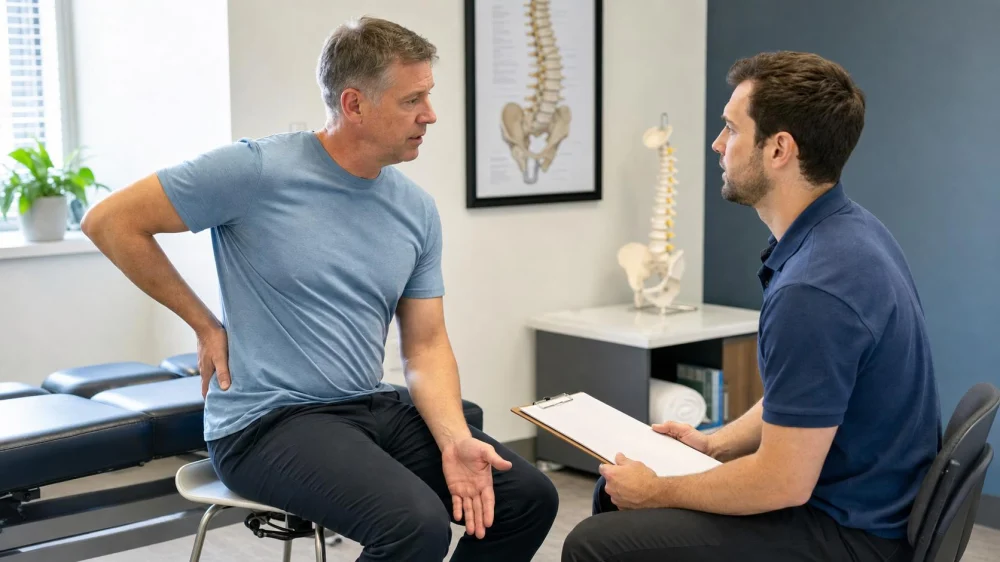
- The clinician should ask about onset, location, radiation, trauma, neurologic symptoms, systemic symptoms, medical history, and prior treatment.
- An appropriate physical examination should assess function and identify findings that require referral.
- The clinician should explain the working assessment, proposed treatment, alternatives, expected course, and meaningful risks.
- Imaging should answer a clinical question rather than be ordered automatically for every episode.
- When signs fall outside the clinician's scope or raise concern, care should be deferred and referral arranged.
A licensed chiropractor can participate in musculoskeletal assessment, but chiropractic care should not delay emergency or medically indicated evaluation.
Prepare useful information
- When and how the pain began, including injury or unusual activity.
- Exact location and whether symptoms travel into an arm, leg, chest, or abdomen.
- Any weakness, numbness, balance change, urinary or bowel change, fever, or weight loss.
- What worsens or relieves symptoms and whether rest or nighttime changes them.
- Current medicines, diagnoses, pregnancy status, surgeries, and prior imaging.
- What treatments were tried and the response, including adverse effects.
Stop and reassess during care
Stop the activity or treatment and seek reassessment if pain suddenly becomes severe, new weakness or numbness appears, balance changes, symptoms spread, or bladder or bowel control changes. New neurologic symptoms after any intervention should not be dismissed as a normal adjustment response.
Expected temporary soreness and a dangerous change are not the same. Ask the clinician in advance which effects may occur, how long they should last, and exactly what requires urgent contact.
Limitations and important notes
This article provides triage education, not a diagnosis or a complete red-flag screening tool. Symptoms can be subtle, and serious conditions do not always follow a checklist. When you are unsure about new or rapidly changing symptoms, obtain professional medical guidance.
Children, pregnancy, older adults, people with cancer or immune suppression, and those using anticoagulants may need different thresholds and examination. Do not use online exercises, stretching, or manipulation to test a possible serious condition.
Frequently asked questions
Does severe pain always mean a dangerous condition?
No, and some serious conditions may begin with moderate pain. Severity is one part of the decision; neurologic signs, trauma, systemic symptoms, history, and progression matter.
Can I see a chiropractor after a minor back strain?
A licensed clinician should first determine whether the presentation fits their scope and whether red flags are absent. Treatment choice should reflect your diagnosis, preferences, health history, and available alternatives.
Do I need imaging before chiropractic care?
Not automatically. Imaging is generally selected when history and examination identify a question it can answer. Red flags may warrant medical assessment and targeted testing.
Is numbness always an emergency?
Not every brief tingling sensation is an emergency, but new, persistent, spreading, or worsening numbness—especially with weakness, walking difficulty, trauma, or bladder or bowel changes—needs prompt evaluation.
What if back pain has lasted several weeks?
Arrange a medical assessment if it is not improving, is worsening, or affects function. Persistent pain may need a revised diagnosis and coordinated treatment plan.
Sources and evidence notes
The National Institute of Arthritis and Musculoskeletal and Skin Diseases back pain overview advises medical review for persistent pain and for symptoms including numbness, severe pain, injury, urinary difficulty, leg weakness or numbness, fever, and unintended weight loss. MedlinePlus numbness and tingling guidance identifies loss of movement and bladder or bowel control as emergency signs.
Next steps
Use the emergency list first. If no emergency sign is present, write a symptom timeline and call an appropriate clinician for triage when warning factors or persistent symptoms apply. Bring your complete history to any chiropractic consultation and expect a clear referral plan if the presentation is not suitable for manual care.






 Kaizen Health & Wellness Center5.0 (5 reviews)
 Fuel Sport & Spine5.0 (148 reviews)
 Bloomingdale Chiropractic Center4.0 (9 reviews)
 Holden Chiropractic5.0 (5 reviews)
 Sage Clinic Chiropractic Newtown Square5.0 (321 reviews)
 Kristen L Staula, DC4.0 (4 reviews)
 Chiropractic for Joint Health: Improving Flexibility and Reducing Pain
 Is How Often to Visit a Chiropractor Affecting Your Daily Life? Here's How a Chiropractor Can Help
 Expert Tips for Managing Chiropractic Safety Naturally with Chiropractic Care
 Can Chiropractic Care Solve Your Lower Back Pain Problem?
 Chiropractic Approaches for Managing Joint and Muscle Pain
 How Chiropractors Help With Migraines and Why It Works – A Natural Treatment Option