
- why-desk-job-posture-affects-your-spine - Why Desk Job Posture Affects Your Spine
- common-desk-job-posture-problems-and-early-signs - Common Desk Job Posture Problems and Early Signs
- how-poor-posture-leads-to-spinal-issues - How Poor Posture Leads to Spinal Issues
- real-case-sarahs-experience-with-ergonomic-fatigue - Real Case: Sarah’s Experience With Ergonomic Fatigue
- simple-corrections-you-can-start-today - Simple Corrections You Can Start Today
- long-term-impact-on-spinal-health - Long-Term Impact on Spinal Health
- how-chiroscope-helps-you-fix-it-right - How ChiroScope Helps You Fix It Right
1. Why Desk Job Posture Affects Your Spine
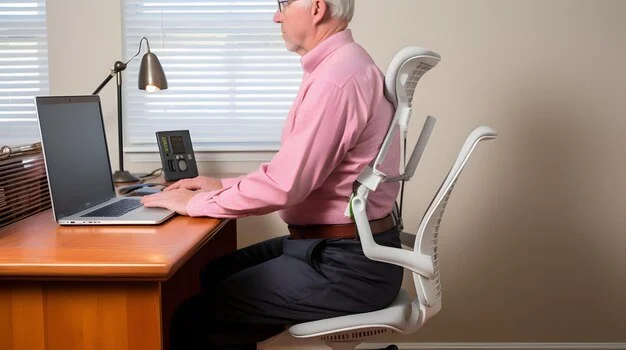
It might feel harmless to slump at your desk for hours, but your spine disagrees. A desk job often encourages static posture, repetitive strain, and a forward head position. Over time, this leads to imbalances in your spinal alignment, putting pressure on vertebrae, muscles, and discs—especially in the cervical and lumbar regions.
Understanding the connection between desk job posture problems and your spine is the first step toward reversing the damage. And yes, even your expensive ergonomic chair can’t fully save you without proper posture habits.
2. Common Desk Job Posture Problems and Early Signs
2.1 Forward Head Posture (FHP)
The classic “turtle neck” where your chin juts forward is one of the earliest signs. This posture adds strain to your upper spine, leading to tension headaches and neck pain.
2.2 Rounded Shoulders
Hunched shoulders cause upper back tightness, breathing difficulties, and even shoulder impingement syndromes. Most people develop this subtly while typing or texting.
2.3 Pelvic Tilt
Sitting with the pelvis rocked forward or backward misaligns the lumbar spine, often triggering lower back pain and stiffness that worsens over time.
3. How Poor Posture Leads to Spinal Issues
Posture-related spinal issues don't happen overnight—they develop slowly and silently. Over time, postural stress changes your spine’s natural curve, compresses discs, and can even lead to nerve impingement or sciatica.
Muscles like the psoas, hip flexors, and deep spinal stabilizers become either too tight or too weak, compromising your body's core balance and triggering pain in seemingly unrelated areas like the knees or shoulders.
4. Real Case: Sarah’s Experience With Ergonomic Fatigue
Sarah, a 32-year-old graphic designer from Austin, spent 10+ hours a day at her desk. Within two years, she began experiencing persistent headaches and numbness in her fingers. After visiting a chiropractor, she learned her symptoms stemmed from a misaligned cervical spine due to chronic forward head posture.
A posture-focused rehabilitation program, regular chiropractic care, and subtle workstation adjustments resolved most of her issues within six months. It all started with a better understanding of how her desk job was impacting her spine.
5. Simple Corrections You Can Start Today
5.1 The 90-90-90 Rule
Adjust your workstation so your elbows, hips, and knees are all at 90 degrees. Feet flat on the floor, screen at eye level—no exceptions.
5.2 Micro-Movements Every 30 Minutes
Set reminders to stand, stretch, and reset your posture every 30 minutes. Even a brief walk or shoulder roll can make a major difference long-term.
5.3 Strengthening and Mobilization
Include targeted exercises like thoracic extensions, chin tucks, and glute bridges to reinforce good posture and stabilize the spine.
6. Long-Term Impact on Spinal Health
Neglecting your posture doesn't just lead to discomfort—it can escalate to chronic back pain, degenerative disc disease, or spinal stenosis in extreme cases. Poor desk posture has also been linked to reduced lung capacity, poor digestion, and mental fatigue due to decreased circulation and oxygenation.
Taking corrective action early ensures you stay mobile and pain-free well into later life.
7. How ChiroScope Helps You Fix It Right
At ChiroScope, we combine chiropractic insight with ergonomic science to help desk workers identify, correct, and prevent spinal issues linked to posture. Whether you're looking for expert-guided exercises, posture-correcting tools, or consultations with certified professionals, ChiroScope offers tailored recommendations for your unique spinal health journey.
Don't wait until the pain becomes unbearable. Take the first step toward better spinal wellness—your spine will thank you.






 Lebanon Chiropractic & Fitness4.0 (75 reviews)
 John Rubino, DC5.0 (2 reviews)
 Stuart T. Martin, D.C.5.0 (5 reviews)
 Gates Chiropractic Office5.0 (25 reviews)
 East Allen Chiropractic Center5.0 (13 reviews)
 Y-Strap Doc Tampa4.0 (139 reviews)
 Chiropractic vs Physical Therapy: Which Is Better for Your Spine?
 The Link Between Chiropractic Care and Better Sleep Quality: How Chiropractic Treatments Can Improve Your Sleep
 Can Chiropractic Help in Managing Symptoms of Fibromyalgia?
 How Chiropractic Treatment Can Help With Stress-Induced Conditions
 Top Questions About Frozen Shoulder Relief Answered by Chiropractors
 Chiropractic Adjustments for Releasing Tension and Promoting Relaxation